![[personal profile]](https://www.dreamwidth.org/img/silk/identity/user.png) imomus
imomusNick, aren't you a bit sick of all this talk about postmodernism?
Yeah, totally. And I'm going to stop soon. But I should probably follow my own advice from yesterday: I should stop talking about postmodernism by talking postmodernism up to the hilt and down to the silt, rather than running away from it. Ride that snake right to the bottom of the pit, and discover the secret trapdoor that leads to the next thing!
Okay, well, let's do the whole alpha and omega thing, then. When did postmodernism begin?

This is quite arbitrary, but I like to think of 1956 as the 'Big Bang' year for postmodernism. Elvis Presley's first single came out that year, and a mixed media art and architecture show called 'This Is Tomorrow' opened at London's Whitechapel Gallery. The show included work by Eduardo Paolozzi and Richard Hamilton which more or less established the Pop Art genre later popularised by Andy Warhol. Just as you can draw a direct line from Andy Warhol to the Velvet Underground, you can draw a direct line from Richard Hamilton to Roxy Music because he taught Bryan Ferry, who named 'Virgina Plain' after one of his paintings. (Reyner Banham was also in the show, and he's on the sleeve of my new album! In fact, if Elvis started mainstream pop music as we know it, the Pop Art of the Independent Group has been much more important to what I think of as 'indie' music and art rock.)
Tell me more about The Independent Group.
Here's a blurb from an MIT Press book about The Independent Group:

'The Independent Group, or the IG, as it was called, is best known for having launched Pop Art. But the young artists, architects, and critics who met informally at London's Institute of Contemporary Arts in the early 1950s were actually embarked on a far more subversive and constructive mission than the founding of an art movement. Street-smart, anti-academic, and iconoclastic, they embraced Hollywood and Madison Avenue and rejected the traditional dichotomies between high and low culture, British and American values. They used their meetings and exhibitions to challenge the official modernist assumptions of British aesthetics and to advocate instead a media-based, consumer-based aesthetics of change and inclusiveness - an aesthetics of plenty. In doing so they drew upon Dadaist, Futurist, and Surrealist strategies to invigorate their alternative version of modernism - a version that today can be said to have insinuated the terms of postmodernism.'
If you want to know more, there's a great essay on the Independent Group by Hal Foster in the New Left Review. It talks about the typically postmodern paradox of a bunch of left wingers who were fascinated by the mediated images they were getting of America's consumerist paradise. And it contains this interesting sentence: 'Richard Hamilton practises an ‘ironism of affirmation’ toward Pop culture (he borrows the phrase from his mentor Duchamp) or, in his own words, a ‘peculiar mixture of reverence and cynicism’.'
An 'aesthetics of plenty', a 'peculiar mixture of reverence and cynicism', Elvis Presley breaking in America, the Independent Group brainstorming in London... it's all looking quite postmodern already. But it doesn't exactly add up to a Big Bang, does it? What else is going on that year in other places?


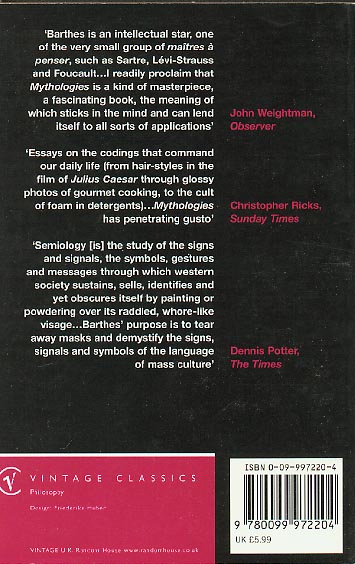
Well, over in Paris Roland Barthes is writing 'Mythologies', his book of essays on such things as the way the new Citroen looks like a medieval cathedral or how Charlton Heston's hairstyle seems suspiciously modern in a Hollywood gladiator movie. 'Mythologies' is still the template today for cultural journalism. Meanwhile, Jean-Luc Godard, a journalist at Cahiers du Cinema, is raving about populist British / American directors like Hitchcock and John Ford, as you can see from the Top 10 lists he starts publishing that year. Even if Godard hadn't invented postmodern editing and pastiche when he made 'Breathless', he would go down in pomo history for inventing the Top 10 List, an important part of pomo ephemera / trivia culture!
Just ten years before that, in 1946, Jean-Paul Sartre gave a lecture called 'Existentialism is a Humanism'. Is postmodernism a humanism too?
There's no contradiction between humanism and postmodernism -- at least no more than there was a contradiction between humanism and enlightenment (and that's quite a big caveat, as Adorno et al point out in 'Dialectic of Enlightenment').
Okay, I'll read that tonight. I'm getting bored, Nick, let's cut to the chase. Do you have any idea what will replace postmodernism?
Yes. It's already clear what will replace postmodernism. Posthumanism. The era of gentech, the blending of manbrain and machinebrain, of the posthuman and of 'digital flesh' (copyright Arthur and Marilouise Kroker) is the next thing. Never mind humanist, postmodernism may well be the last cultural movement that's 100% human.
Was September 11th 2001 -- said by some to mark the end of irony -- also the end of postmodernism?


No, 9/11 is a totally pomo event. Bin Laden is a completely pomo phenomenon, in the sense that his Islamic fundamentalism is in a simple dialectic with the west's 'aesthetics of plenty'. In fact, you could argue that Bin Laden is a pomo rockist in just the same way that Michael Gira sets Devendra Banhart up to be. Bin Laden and Banhart both exist in the present and use postmodern technology and the media to further their goals, but condemn the contemporary and harken back to a notionally more 'pure' time when people were 'less corrupted'. This apparent denial of postmodernism is actually an integral part of its dialectics. Bin Laden probably gave pomo an extra 20 years of life when he arranged 9/11. It was looking, in the 90s, to be morphing into 'the posthuman'. But Bin Laden brought things back to the old pomo binaries: sincere / ironic, real / fake, past / present, anorexia / bulemia...
Bin Laden and Banhart also both have beards. Hmm. So if postmodernism didn't end with 9/11, when will it end?
You may laugh at this prediction now, but you won't laugh in 2012: the point at which postmodernism turns into posthumanism is the moment when Arnold Schwarzenegger becomes president of the US. That's the point at which the pomo fight between the authentic and the fake morphs into the posthuman fight between flesh and digital flesh. He will be elected to 'terminate' Islamic fundamentalism, a dialectic that will by that point be a bit tired, but he will actually be the first 'terminator president', and herald in an age of unprecedented man-machine combination.


Oh shit! I hope you're wrong! I'm starting to feel nostalgic for postmodernism already!
Yes, it's such a lovely word, isn't it, 'postmodernism'? It sounds friendly and warm, like logs crackling in the grate. Whereas 'posthuman'... brrrr!
I'm trying to imagine what cultural life will be like in the world of the posthuman? Will it be very different from cultural life in postmodernism?
Well, just as there as continuities between modernism and postmodernism, so there will be continuities between the postmodern and the posthuman. The rockist questions about authenticity will not go away -- in fact, they'll become, if anything, more central. But with a twist: it will be the clones and the machines that'll harp on most about stuff like authenticity and humanity, whereas the humans will insist on artificiality. Everyone will have an anxiety about their differences, which will make them rush for common ground.
So the future is Robot Rockism?
I'm afraid so, my digital friend. Now, time to switch you off, your batteries need recharging!
Yeah, totally. And I'm going to stop soon. But I should probably follow my own advice from yesterday: I should stop talking about postmodernism by talking postmodernism up to the hilt and down to the silt, rather than running away from it. Ride that snake right to the bottom of the pit, and discover the secret trapdoor that leads to the next thing!
Okay, well, let's do the whole alpha and omega thing, then. When did postmodernism begin?
This is quite arbitrary, but I like to think of 1956 as the 'Big Bang' year for postmodernism. Elvis Presley's first single came out that year, and a mixed media art and architecture show called 'This Is Tomorrow' opened at London's Whitechapel Gallery. The show included work by Eduardo Paolozzi and Richard Hamilton which more or less established the Pop Art genre later popularised by Andy Warhol. Just as you can draw a direct line from Andy Warhol to the Velvet Underground, you can draw a direct line from Richard Hamilton to Roxy Music because he taught Bryan Ferry, who named 'Virgina Plain' after one of his paintings. (Reyner Banham was also in the show, and he's on the sleeve of my new album! In fact, if Elvis started mainstream pop music as we know it, the Pop Art of the Independent Group has been much more important to what I think of as 'indie' music and art rock.)
Tell me more about The Independent Group.
Here's a blurb from an MIT Press book about The Independent Group:
'The Independent Group, or the IG, as it was called, is best known for having launched Pop Art. But the young artists, architects, and critics who met informally at London's Institute of Contemporary Arts in the early 1950s were actually embarked on a far more subversive and constructive mission than the founding of an art movement. Street-smart, anti-academic, and iconoclastic, they embraced Hollywood and Madison Avenue and rejected the traditional dichotomies between high and low culture, British and American values. They used their meetings and exhibitions to challenge the official modernist assumptions of British aesthetics and to advocate instead a media-based, consumer-based aesthetics of change and inclusiveness - an aesthetics of plenty. In doing so they drew upon Dadaist, Futurist, and Surrealist strategies to invigorate their alternative version of modernism - a version that today can be said to have insinuated the terms of postmodernism.'
If you want to know more, there's a great essay on the Independent Group by Hal Foster in the New Left Review. It talks about the typically postmodern paradox of a bunch of left wingers who were fascinated by the mediated images they were getting of America's consumerist paradise. And it contains this interesting sentence: 'Richard Hamilton practises an ‘ironism of affirmation’ toward Pop culture (he borrows the phrase from his mentor Duchamp) or, in his own words, a ‘peculiar mixture of reverence and cynicism’.'
An 'aesthetics of plenty', a 'peculiar mixture of reverence and cynicism', Elvis Presley breaking in America, the Independent Group brainstorming in London... it's all looking quite postmodern already. But it doesn't exactly add up to a Big Bang, does it? What else is going on that year in other places?
Well, over in Paris Roland Barthes is writing 'Mythologies', his book of essays on such things as the way the new Citroen looks like a medieval cathedral or how Charlton Heston's hairstyle seems suspiciously modern in a Hollywood gladiator movie. 'Mythologies' is still the template today for cultural journalism. Meanwhile, Jean-Luc Godard, a journalist at Cahiers du Cinema, is raving about populist British / American directors like Hitchcock and John Ford, as you can see from the Top 10 lists he starts publishing that year. Even if Godard hadn't invented postmodern editing and pastiche when he made 'Breathless', he would go down in pomo history for inventing the Top 10 List, an important part of pomo ephemera / trivia culture!
Just ten years before that, in 1946, Jean-Paul Sartre gave a lecture called 'Existentialism is a Humanism'. Is postmodernism a humanism too?
There's no contradiction between humanism and postmodernism -- at least no more than there was a contradiction between humanism and enlightenment (and that's quite a big caveat, as Adorno et al point out in 'Dialectic of Enlightenment').
Okay, I'll read that tonight. I'm getting bored, Nick, let's cut to the chase. Do you have any idea what will replace postmodernism?
Yes. It's already clear what will replace postmodernism. Posthumanism. The era of gentech, the blending of manbrain and machinebrain, of the posthuman and of 'digital flesh' (copyright Arthur and Marilouise Kroker) is the next thing. Never mind humanist, postmodernism may well be the last cultural movement that's 100% human.
Was September 11th 2001 -- said by some to mark the end of irony -- also the end of postmodernism?
No, 9/11 is a totally pomo event. Bin Laden is a completely pomo phenomenon, in the sense that his Islamic fundamentalism is in a simple dialectic with the west's 'aesthetics of plenty'. In fact, you could argue that Bin Laden is a pomo rockist in just the same way that Michael Gira sets Devendra Banhart up to be. Bin Laden and Banhart both exist in the present and use postmodern technology and the media to further their goals, but condemn the contemporary and harken back to a notionally more 'pure' time when people were 'less corrupted'. This apparent denial of postmodernism is actually an integral part of its dialectics. Bin Laden probably gave pomo an extra 20 years of life when he arranged 9/11. It was looking, in the 90s, to be morphing into 'the posthuman'. But Bin Laden brought things back to the old pomo binaries: sincere / ironic, real / fake, past / present, anorexia / bulemia...
Bin Laden and Banhart also both have beards. Hmm. So if postmodernism didn't end with 9/11, when will it end?
You may laugh at this prediction now, but you won't laugh in 2012: the point at which postmodernism turns into posthumanism is the moment when Arnold Schwarzenegger becomes president of the US. That's the point at which the pomo fight between the authentic and the fake morphs into the posthuman fight between flesh and digital flesh. He will be elected to 'terminate' Islamic fundamentalism, a dialectic that will by that point be a bit tired, but he will actually be the first 'terminator president', and herald in an age of unprecedented man-machine combination.
Oh shit! I hope you're wrong! I'm starting to feel nostalgic for postmodernism already!
Yes, it's such a lovely word, isn't it, 'postmodernism'? It sounds friendly and warm, like logs crackling in the grate. Whereas 'posthuman'... brrrr!
I'm trying to imagine what cultural life will be like in the world of the posthuman? Will it be very different from cultural life in postmodernism?
Well, just as there as continuities between modernism and postmodernism, so there will be continuities between the postmodern and the posthuman. The rockist questions about authenticity will not go away -- in fact, they'll become, if anything, more central. But with a twist: it will be the clones and the machines that'll harp on most about stuff like authenticity and humanity, whereas the humans will insist on artificiality. Everyone will have an anxiety about their differences, which will make them rush for common ground.
So the future is Robot Rockism?
I'm afraid so, my digital friend. Now, time to switch you off, your batteries need recharging!
![[identity profile]](https://www.dreamwidth.org/img/silk/identity/openid.png)
Mo' Pomo
Date: 2004-10-30 07:25 am (UTC)Being ever distrustful of critics, I think we have to be reminded that these labels are usually only easy to apply after the fact--and in fact, labels can be peeled off and new ones placed over them. I wonder how many artists have consciously ever thought, "I am a postmodernist." Or, now, "I will become a posthumanist." I suppose Momus does; maybe it comes easier for musicians and possibly visual artists. But writers? Even the critics themselves? Sure, one of the criteria of being a postmodernist must be self-consciousness, but it seems so often that interesting, good art is made by people who aren't fully consciously aware of what it is exactly that they are doing, or where it falls in relation to the other cultural artefacts of the time. (Though when I write, I do feel myself looking over my own shoulder, and am only too aware that art can only really hope to preserve the past, not stop time or pretend to see the future.)
Although I'm not denying for a minute that we are in and currently leaving what we can conveniently call the postmodern era, in every era there have been artists who have been affected by and learned to manipulate the latest technological advances, whether it be the clay tablet, the Gutenberg press, or the manual typewriter and photogravure. I'm reading Alfred Jarry's "How to Build a Time Machine" right now and it strikes me as the most amazing postmodernist document I've ever witnessed outside an art gallery or TV commercial. So, has some form of postmodernism always been, and is it forever?
Re: Mo' Pomo
Date: 2004-10-30 08:35 am (UTC)Re: Mo' Pomo
Date: 2004-10-30 12:23 pm (UTC)That's not really the concensus opinion among art historians, though. The artists that hold the highest status in the contemporary canon (Duchamp, Warhol, Buren, Broodthaers) have little to recommend them other than an extreme consciousness of their position in history and how to manipulate it. Ever since artists and critics decided to follow the path set by minimalism and conceptualism (i.e. the path of theory), self-awareness has been held as the highest value.
Re: Mo' Pomo
Date: 2004-10-30 02:51 pm (UTC)Re: Mo' Pomo
Date: 2004-10-31 05:00 am (UTC)Fassbinder
Eustache
Basquiat
Bukowski
Pollock