![[personal profile]](https://www.dreamwidth.org/img/silk/identity/user.png)
Hello! This is Click Opera.
Feb. 10th, 2010 03:39 am1. What's this? This is the last entry in the blog called Click Opera, which means that, in the funny through-the-looking-glass world of blogs, it's the first page future internauts and web adventurers will come to. So think of this not so much as an ending as an entrance. What you've reached is the door to "probably the best-written blog on the Anglophone web", according to Warren Ellis. "It doesn't get any better than Click Opera," said novelist Dennis Cooper.

2. Who's behind Click Opera? The best introduction to who I am is this article in The Guardian Review. I'm a Scot, a musician, a writer, and -- according to this page, gulp! -- the 4697th most significant contemporary visual artist working today. My Wikipedia page is here. You can download six of my early albums free here. Books I've written are here and here. I want to write more books, so if you're a publisher email me! That goes for people wanting to reproduce bits of this blog in print, too.
3. Where can we find out what you're up to, post-blog? From my "personal digital assistant" Maria Wolonski, who announces my engagements in the charming, ringing tones of a talking clock. From the Momus concerts page on LastFM. From my Flickr page and my two YouTube accounts, momasu and bookofjokes. I may even revive my old website (1995-2003), imomus.com.
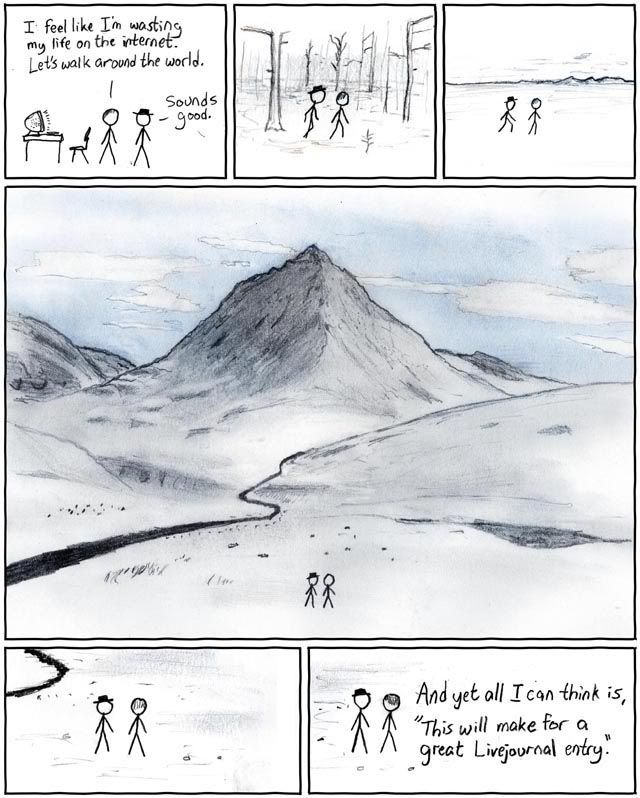
4. What do you plan to do now? I want to write books and articles. Maybe teach at an art school. Deliver lectures in many lands. Make some more records. Play concerts. Walk around the world. Learn to speak Japanese and live in Japan. Write my own regular newspaper column of cultural commentary (I've written for people like Wired, The New York Times, Frieze, Spike, The Wire, 032c). Hold some more art shows. If you can help me realise these dreams, email me, please!
5. If I want to stage a Momus concert, what do I need to do? Tell your friendly local promoter (or it could be an art gallerist, store owner, festival director) that all I require is travel expenses (from Berlin), accommodation, plus a fee of around €500 for a regular Momus show (festivals tend to pay more). If that works for the promoters, get them to drop me a line and we'll take it from there. I also do art performances -- live storytelling and unreliable tours.

6. Will you keep the Click Opera archive up indefinitely? Yes, I will. If you feel like helping with the modest LiveJournal and PhotoBucket hosting costs -- or compensating me directly for some illegal mp3s of my songs you've downloaded -- you can make a donation via PayPal here.
7. What's the best way to search the Click Opera archive? Simply type the word imomus plus your search term into a search engine, then follow the links headed "Click Opera".
8. Will you keep reading and responding to comments left under this entry? Yes, I will. Leave your email address if you want a personal response.
9. Why did you stop updating Click Opera? Not because anything went wrong or it got unpleasant. Quite the reverse, in fact. Click Opera was just too damned good: too compelling, too time-consuming, too satisfying. It took over my life. It became my job, the main topic of my conversation, the hub of my self-mediated fame: "Aren't you that guy from the internet?" (Read the piece called Clickswansong if you want to know more about why this blog came to a "happy ending". Or listen to this radio interview with KCSB's Colin Marshall.)
10. Can I step through the door now? Please do! There's a lot to read! You can browse backwards from here, or start at the beginning (Thursday January 15th 2004) and work forwards. The calendar is your friend, or you may prefer to read through the titles displayed in the month view.
Thanks to everyone who's contributed to Click Opera, this big vineyard! You've given me years of pleasure! Happiness, as T.E. Lawrence said, "is a by-product of absorption", and blogging -- the best hobby I ever had -- has been absorbing indeed.

2. Who's behind Click Opera? The best introduction to who I am is this article in The Guardian Review. I'm a Scot, a musician, a writer, and -- according to this page, gulp! -- the 4697th most significant contemporary visual artist working today. My Wikipedia page is here. You can download six of my early albums free here. Books I've written are here and here. I want to write more books, so if you're a publisher email me! That goes for people wanting to reproduce bits of this blog in print, too.
3. Where can we find out what you're up to, post-blog? From my "personal digital assistant" Maria Wolonski, who announces my engagements in the charming, ringing tones of a talking clock. From the Momus concerts page on LastFM. From my Flickr page and my two YouTube accounts, momasu and bookofjokes. I may even revive my old website (1995-2003), imomus.com.
4. What do you plan to do now? I want to write books and articles. Maybe teach at an art school. Deliver lectures in many lands. Make some more records. Play concerts. Walk around the world. Learn to speak Japanese and live in Japan. Write my own regular newspaper column of cultural commentary (I've written for people like Wired, The New York Times, Frieze, Spike, The Wire, 032c). Hold some more art shows. If you can help me realise these dreams, email me, please!
5. If I want to stage a Momus concert, what do I need to do? Tell your friendly local promoter (or it could be an art gallerist, store owner, festival director) that all I require is travel expenses (from Berlin), accommodation, plus a fee of around €500 for a regular Momus show (festivals tend to pay more). If that works for the promoters, get them to drop me a line and we'll take it from there. I also do art performances -- live storytelling and unreliable tours.
6. Will you keep the Click Opera archive up indefinitely? Yes, I will. If you feel like helping with the modest LiveJournal and PhotoBucket hosting costs -- or compensating me directly for some illegal mp3s of my songs you've downloaded -- you can make a donation via PayPal here.
7. What's the best way to search the Click Opera archive? Simply type the word imomus plus your search term into a search engine, then follow the links headed "Click Opera".
8. Will you keep reading and responding to comments left under this entry? Yes, I will. Leave your email address if you want a personal response.
9. Why did you stop updating Click Opera? Not because anything went wrong or it got unpleasant. Quite the reverse, in fact. Click Opera was just too damned good: too compelling, too time-consuming, too satisfying. It took over my life. It became my job, the main topic of my conversation, the hub of my self-mediated fame: "Aren't you that guy from the internet?" (Read the piece called Clickswansong if you want to know more about why this blog came to a "happy ending". Or listen to this radio interview with KCSB's Colin Marshall.)
10. Can I step through the door now? Please do! There's a lot to read! You can browse backwards from here, or start at the beginning (Thursday January 15th 2004) and work forwards. The calendar is your friend, or you may prefer to read through the titles displayed in the month view.
Thanks to everyone who's contributed to Click Opera, this big vineyard! You've given me years of pleasure! Happiness, as T.E. Lawrence said, "is a by-product of absorption", and blogging -- the best hobby I ever had -- has been absorbing indeed.


 * "To impose exactly the same sort of multiculturalism worldwide would not be multiculturalism at all, but a kind of monoculture. It would result in a decrease in diversity," I added. "Japan is not a hegemonic power in the world today. The US is. Therefore, I see the maintenance of Japaneseness as a form of resistance struggle. It opposes the homogenising globalisation which proposes the US model as the one we must all follow."
 I escaped yesterday from winter-glitched Berlin (grit, dark, dirt, slush and slither) into the warm, clean capsule of sunlight-and-elsewhere which is the


 Humble, fleeting, homemade, ramshackle and cheap, the self-fab skyhut is admirable in all sorts of ways. Okay, so the toilet appears to be in the kitchen in some of these photos, and they wouldn't keep the cold out if Hong Kong ever did get cold (today it's 20c, perfect!). But from the point of view of density, recycling, efficiency and sustainability these structures -- built in a spirit of dung-beetle bricolage -- have a lot to teach us. Up on the roof it's cooler and quieter, you're out of people's way, you have good views out over the city, you can befriend the birds and watch the sun set. You haven't used up any extra land, and you haven't spent a ridiculous amount of money on construction. You're up on the roof, hurting no-one, minding your own business, listening to the aircon.


 Akiko Watanabe, who runs Motto, has just acquired this captivating beast -- a white-pawed small black cat, two months old, with huge pupils and a miniaturised instinct to murder. For this kitten (I didn't discover its name), Motto's piles of arty, gorgeous, intelligent and obscure books are nothing more than rocky outcrops in a tiny landscape, a "killing fields" populated by "mice" and "birds" evoked by a playful customer's wriggling, darting hands. For the kitten, a free handout advertising an art event, rattled in the air overhead, is enough to make a half-convincing sparrow.
 What would be in it for me? Well, I'd find a populist peg to hang an unpopular blog entry on, for a start. Look, a kitten! But also, by making a free viral ad for Motto, I'd lessen my guilt about the freeloading way I tend to use the store myself: browsing the interesting paper publications Akiko has curated, noting the most intriguing names and URLs, then going home and downloading free PDFs and JPGs of the stuff off the internet. Look, everyone! A kitten! At Motto!


 I want to change my mind. It's not that I was wrong about the nihilism of heat, or the cultural connection between hot places and a certain moral insouciance. It's that I didn't give the whole picture. There's a nihilism of cold too.


 In 455AD the Vandals -- the tribal name people from the area of today's eastern Germany and Poland were called back then -- sacked Rome, which is where we get the modern sense of the word "vandalism", meaning "senseless destruction, particularly in diminution of aesthetic appeal or destruction of objects that were completed with great effort." But wait, we're jumping ahead.
 Dirty ice and crusty snow weighs heavy on Berlin; the pavement might have a little plowed catwalk you can mince cautiously along if you're lucky, but mostly you just have to slither and plod across it. The bushes outside my living room window were unlucky enough to develop a canopy of snow which kept getting heavier until the plants caved in completely. They now lie crushed under a massive snowdrift. Step outside and you're apparently wearing no trousers, and someone's apparently spraying hydrochloric acid in your face.
 That's the attitude of the downtrodden-looking middle-class majority, dowdy in jeans and boots and fleece jackets. But -- compared with Japan -- Berlin is also full of "underground people" who seem, in winter, to be more mad and desperate and poor than usual. The squat types with their big dogs look more embattled, the illegal U-Bahn ticket-sellers won't take no for an answer, and the alkies are drunker and more intrusive.
 My trips to and from the Berlin airport at either end of my Japan trip were characterised by similar encounters. On the way to Tegel in early December I was menaced by a madman who shouted (rather presciently) "Japan! Japan! Okay? Okay?" at me, but in a super-threatening way, as if I was personally insulting him. (I was dressed in Japanese style, with tenugui and cloak.) On the way back, on Monday evening, it was people shouting "Pirat!" My nerves were frazzled by 12 hours on jets, and having to lug heavy suitcases across the snow (the bus-driver decided, just two stops from the airport, for reasons of his own, to dump us at the kerbside), and I felt a sudden urge to pile into the idiots shouting at me. Six weeks in Japan had raised my standards for public behaviour to levels that Berlin doesn't come anywhere near.
 When the time came to exit the building the lady at the front desk called out a challenge so peremptory, rude and familiar that I assumed it couldn't possibly be for me, and walked straight past. Alarmed that she hadn't signed me in, she was in fact demanding which company I'd been seeing. It was her tone, though, that was so brash, entitled, authoritarian. I wish I could say she's a one-off, but there are times when everybody in Berlin seems like that. You go into a shop, just back from Japan, and expect the local version of a cheerful irrashaimase! Instead you get a sort of scowl that seems to say "What the fuck do you want, you weird pirate-looking guy?" Even when you say "Guten Tag!" you may well get no response.
 It would be lovely to paint it as principled protest, but let's face facts: some Berliners have a self-righteousness about their incapacity, their unemployment, their non-participation in what they call the Scheisse-System. It's an attitude of arrogance-in-failure you just don't encounter in Asia. Osaka has a lot of poverty, but you sense that everybody tries their best, and that there's a warm glow of positive affect towards society, and towards collective property. The ugly tagging and name-scratching (and what could be a better symbol of the assertion of an ugly, arrogant individualism over collective property?) that blights every available surface (except, inexplicably, private cars) here is largely absent from Japan, where clear train windows and pristine plush fabric seat covers are still possible. In Berlin the council covers windows and seats with ugly patterns designed to deter taggers and name-scratchers.
 My own "next level" with Vampire Weekend was