![[personal profile]](https://www.dreamwidth.org/img/silk/identity/user.png) imomus
imomusFirst there was GDP, gross domestic product, and the statisticians looked upon their work and saw that it was good. And lo, one of them said "Let us divide GDP by population, for some nations contain multitudes!" And from that day forth there was GDP per capita, and the statisticians saw that they could compare the wealth of a citizen of one country with the wealth of a citizen in any other, and they agreed that this was good.

And so, in today's Japan Times, for instance, an article entitled China as Number Three (a reference to the 1979 book Japan as Number One, now out of print) states: "China as a country is rich, but Chinese are not. GDP per capita in China was $2,800 in 2007; by contrast, in Germany, average income was $38,800. China is ranked among the bottom tier of nations by this yardstick. Chinese are proud of their country's economic accomplishments, but they also measure how the economic development has affected their own lives. The greater the economic disparities, the greater their own discontent."
And lo, the statisticians read sentences like these, and from them came a wailing and a sighing and a gnashing of teeth. How, they wondered, could they develop new indices which measured that subjective thing, well-being?

And then a voice spoke up in a podcast. It was Anil Markandya of the University of Bath, who in 2007 shared the Nobel Peace Prize for his work on climate change. Professor Markandya's lecture is a useful introduction to the new tools which are currently being developed as measures for well-being.
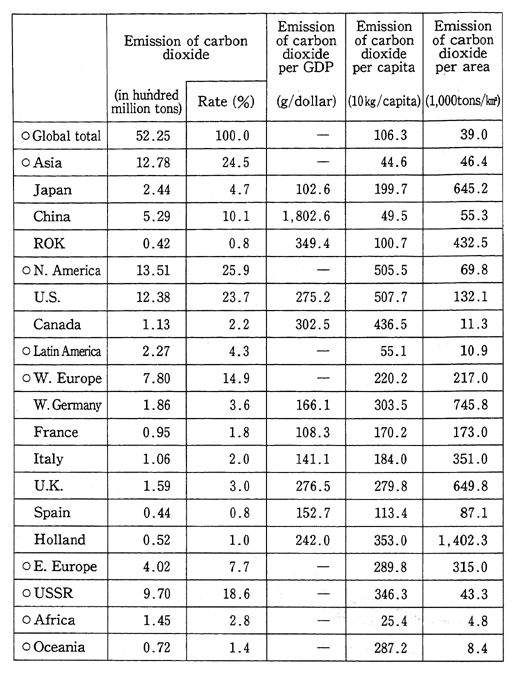
 And lo, the adjustments Professor Markandya suggested to simple measurements of GDP did begin, it has to be said, with his own subject of special interest, sustainability. We must, he said, measure a nation's Ecological Footprint and the environmental damage it creates. We must measure Emissions Per Capita too. But, he continued, the Mac index (the cost of a Big Mac in various places, or purchasing power) is also an adjustment we should make. And so is Unemployment, and the Corruption Perception Index, Life Expectancy, Healthy Life Years, Happy Life Years, Intangible Capital (good governance, the rule of law, education), Social Capital (the network of relations and institutions that make it possible for countries to function well) and Genuine Savings (an adjustment of gross savings to reflect depletion of natural resources and pollution damages).
At this the statisticians grew restive. Many questioned the value of measuring all these intangible things and subtracting their value from the hard science of numbers, as if they were equally objective. Many found it suspicious that the proposed measures happened to tally with the agenda of the World Bank, or with certain eco-campaigns. Some said that the focus on individual nations was wrong, that only a global picture of the symbiosis between all these statistics could create an accurate model. Yet most agreed that these new tools could only increase the demand for trained statisticians, and stake a claim to new territory -- closer to the human soul! -- for their profession. It could only be a matter of time before governments published figures for Sunshine Capital, Orgasm Capital, Morality Capital, and a National War Guilt Index.

Already there were signs of this coming statistical utopia: the Osberg Sharp indicators of consumption, wealth, economic equality and future security (which nevertheless fail to show that the US is the best place to be a rich child, but for the poor child the best place is Norway), or the Human Development Index, a basket of rights and wrongs which shows all nations improving except those in Sub-Saharan Africa (the fall guy region in almost all well-being science, just as Scandinavia tends to be well-being's 800-pound gorilla).
Then there was The Gallup-Healthways Well-Being Index, which sorted Americans into those Thriving, Struggling and Suffering. Conducted in early 2008, this poll already reflected the impact of the gathering financial crisis: "Among the top 10 days with highest levels of reported negative experiences, many were days that coincided with bad news from the financial markets". The same poll, repeated a year later, would certainly show more Americans in the Struggling and Suffering categories, for old-fashioned economic reasons.

Personally, I find the statistics of well-being at its most interesting when it's most pretentious, and reaches for numbers to pin to the most nebulous and perverse impulses of the human psyche. But statisticians have a long way to go before they can match the pretentiousness and inventiveness of market researchers. It was on the occasion of our examination of Kartoffelgrafiken (potato-shaped market segmentation graphics) that we found perhaps the most useful tool yet devised for the measurement of well-being: Kumakouji's graph of Cat Ownership to Yam Appreciation.
But let us never forget the warning in the Book of Revelation: "When accountants get creative and statisticians speak like priests, then the Last Days are upon us."
And so, in today's Japan Times, for instance, an article entitled China as Number Three (a reference to the 1979 book Japan as Number One, now out of print) states: "China as a country is rich, but Chinese are not. GDP per capita in China was $2,800 in 2007; by contrast, in Germany, average income was $38,800. China is ranked among the bottom tier of nations by this yardstick. Chinese are proud of their country's economic accomplishments, but they also measure how the economic development has affected their own lives. The greater the economic disparities, the greater their own discontent."
And lo, the statisticians read sentences like these, and from them came a wailing and a sighing and a gnashing of teeth. How, they wondered, could they develop new indices which measured that subjective thing, well-being?
And then a voice spoke up in a podcast. It was Anil Markandya of the University of Bath, who in 2007 shared the Nobel Peace Prize for his work on climate change. Professor Markandya's lecture is a useful introduction to the new tools which are currently being developed as measures for well-being.
And lo, the adjustments Professor Markandya suggested to simple measurements of GDP did begin, it has to be said, with his own subject of special interest, sustainability. We must, he said, measure a nation's Ecological Footprint and the environmental damage it creates. We must measure Emissions Per Capita too. But, he continued, the Mac index (the cost of a Big Mac in various places, or purchasing power) is also an adjustment we should make. And so is Unemployment, and the Corruption Perception Index, Life Expectancy, Healthy Life Years, Happy Life Years, Intangible Capital (good governance, the rule of law, education), Social Capital (the network of relations and institutions that make it possible for countries to function well) and Genuine Savings (an adjustment of gross savings to reflect depletion of natural resources and pollution damages).At this the statisticians grew restive. Many questioned the value of measuring all these intangible things and subtracting their value from the hard science of numbers, as if they were equally objective. Many found it suspicious that the proposed measures happened to tally with the agenda of the World Bank, or with certain eco-campaigns. Some said that the focus on individual nations was wrong, that only a global picture of the symbiosis between all these statistics could create an accurate model. Yet most agreed that these new tools could only increase the demand for trained statisticians, and stake a claim to new territory -- closer to the human soul! -- for their profession. It could only be a matter of time before governments published figures for Sunshine Capital, Orgasm Capital, Morality Capital, and a National War Guilt Index.
Already there were signs of this coming statistical utopia: the Osberg Sharp indicators of consumption, wealth, economic equality and future security (which nevertheless fail to show that the US is the best place to be a rich child, but for the poor child the best place is Norway), or the Human Development Index, a basket of rights and wrongs which shows all nations improving except those in Sub-Saharan Africa (the fall guy region in almost all well-being science, just as Scandinavia tends to be well-being's 800-pound gorilla).
Then there was The Gallup-Healthways Well-Being Index, which sorted Americans into those Thriving, Struggling and Suffering. Conducted in early 2008, this poll already reflected the impact of the gathering financial crisis: "Among the top 10 days with highest levels of reported negative experiences, many were days that coincided with bad news from the financial markets". The same poll, repeated a year later, would certainly show more Americans in the Struggling and Suffering categories, for old-fashioned economic reasons.
Personally, I find the statistics of well-being at its most interesting when it's most pretentious, and reaches for numbers to pin to the most nebulous and perverse impulses of the human psyche. But statisticians have a long way to go before they can match the pretentiousness and inventiveness of market researchers. It was on the occasion of our examination of Kartoffelgrafiken (potato-shaped market segmentation graphics) that we found perhaps the most useful tool yet devised for the measurement of well-being: Kumakouji's graph of Cat Ownership to Yam Appreciation.
But let us never forget the warning in the Book of Revelation: "When accountants get creative and statisticians speak like priests, then the Last Days are upon us."
![[identity profile]](https://www.dreamwidth.org/img/silk/identity/openid.png)

(no subject)
Date: 2009-01-27 02:40 pm (UTC)(no subject)
Date: 2009-01-27 03:17 pm (UTC)(no subject)
Date: 2009-01-27 05:54 pm (UTC)Song
Date: 2009-01-27 07:12 pm (UTC)Will you ever play 'The Guitar Lesson' at one of your future shows? Your older songs are so fucking haunting, what were you possibly thinking about when you wrote this meisterwerk?
Cheers, Brian.
Re: Song
Date: 2009-01-27 07:32 pm (UTC)What I was thinking when I wrote it is pretty much spelled out here (http://imomus.livejournal.com/421538.html).
Re: Song
Date: 2009-01-27 09:58 pm (UTC)The picture's stuck in my head ever since I've seen it.
Greetings!
-r
Re: Song
Date: 2009-01-27 10:02 pm (UTC)You can find more, for instance, here (http://www.designboom.com/history/mapplethorpe.html).
Re: Song
Date: 2009-01-27 10:45 pm (UTC)Re: Song
Date: 2009-01-27 11:07 pm (UTC)Re: Song
Date: 2009-01-27 11:14 pm (UTC)(no subject)
Date: 2009-01-28 06:58 am (UTC)Huh? Where do you live? The Playboy mansion?