Geek Vagabond Pocketmonster
Sep. 14th, 2008 01:05 am![[personal profile]](https://www.dreamwidth.org/img/silk/identity/user.png) imomus
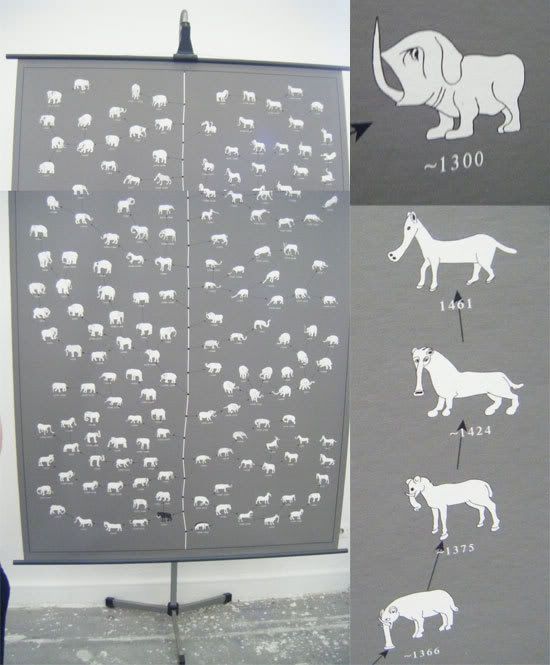
imomusI was in the perfect company to see the exhibition Strich und Faden: Heimat, Volkskunst, und Travestie (running to October 8th at Kunstraum Richard Sorge, Landsberger Allee 54, Berlin) yesterday -- accompanied not just by Hisae and Sunshine, but by Uli Westphal, the elephant taxonomist. Last time I hung out with Uli, I made a taxonomy of Terries, a collection of hipsters sporting post-Terry Richardson moustaches. This time, we stood in front of some new photos by the Dutch photographer and stylist team of Ari Versluis and Ellie Uyttenbroek, who collect similar-looking people on the street, photograph them against a plain white background, cluster the results in groups of twelve, give each group a name, and build up a stock (on their website, in their book, and in exhibitions) of tribes they call Exactitudes.

The Exactitudes Project -- it's being going on for about ten years now -- is a wonderful piece of visual sociology, a taxonomy-in-progress of street style, and a poke in the eye for cherished notions of individuality. "In their quest for heightened individuality and emancipation from the masses," reads the Berlin exhibition handout, "most persons still end up as part of a distinct category. It is this irony that the Exactitudes pictures lovingly and painstakingly document... It seems to question the authenticity of identity, suggesting it may be just another thing to be consumed, the result of fashion, peer pressure or ideology... and present mainstream figures as just another kind of freak". Versluis and Uyttenbroek see style as, essentially, semantic: "There is always a sentence in what people wear," says Versluis. "That can be poetry, or shouting out loud. We try to catch that." And just as language communicates by using familiar signs with fixed, shared meanings, so does visual style.
 It can be a lot of fun trying to work out which group the couple would put us into. Here's how I was dressed when I visited the exhibition yesterday. Having looked at all 96 tribes on the Exactitudes website, I'd say I'm some mixture of Pocketmonster and Vagabond and Geek. A Geek Vagabond Pocketmonster, then, with fruity undertones of Chairman and a cheeky hint of Musulman. Oh, and I'm dating a Bu Ying! and just made an album with a Cassettes Gang.
Are you in there somewhere?
The Exactitudes Project -- it's being going on for about ten years now -- is a wonderful piece of visual sociology, a taxonomy-in-progress of street style, and a poke in the eye for cherished notions of individuality. "In their quest for heightened individuality and emancipation from the masses," reads the Berlin exhibition handout, "most persons still end up as part of a distinct category. It is this irony that the Exactitudes pictures lovingly and painstakingly document... It seems to question the authenticity of identity, suggesting it may be just another thing to be consumed, the result of fashion, peer pressure or ideology... and present mainstream figures as just another kind of freak". Versluis and Uyttenbroek see style as, essentially, semantic: "There is always a sentence in what people wear," says Versluis. "That can be poetry, or shouting out loud. We try to catch that." And just as language communicates by using familiar signs with fixed, shared meanings, so does visual style.
It can be a lot of fun trying to work out which group the couple would put us into. Here's how I was dressed when I visited the exhibition yesterday. Having looked at all 96 tribes on the Exactitudes website, I'd say I'm some mixture of Pocketmonster and Vagabond and Geek. A Geek Vagabond Pocketmonster, then, with fruity undertones of Chairman and a cheeky hint of Musulman. Oh, and I'm dating a Bu Ying! and just made an album with a Cassettes Gang.Are you in there somewhere?
![[identity profile]](https://www.dreamwidth.org/img/silk/identity/openid.png)
(no subject)
Date: 2008-09-14 12:07 pm (UTC)(no subject)
Date: 2008-09-14 12:30 pm (UTC)It's one of fashion's eternal paradoxes that its liberal desire to embrace the grass roots can lead it to cherish illiberal things. But it's also true that meanings are never fixed: a Fred Perry shirt and DMs and braces, for instance, doesn't have to mean "racist bootboy" forever. A lot of the people in the Anti-Nazi League dressed that way too. And when Japanese kids wear swasktikas, they aren't swastikas any more -- and Hitler's ideology, because it's forgotten, is defeated.
Not everyone agrees, of course, including my old mentor Steve Heller, who's argued (http://dcrit.sva.edu/pdfs/heller_postscript.pdf) that the swastika needs to remain taboo forever -- or at least for a very long time. I think that keeps the power, mythology, symbolism and ideology unnecessarily strong and pure, and I think it works only when, like Steve, you frame the question with the concept of redemption, and say that the only two options are that the swastika remain "beyond redemption" or "be redeemed". There's another more neutral fate: that the swastika should become subject to semantic drift and decay, should pop up in a number of different contexts with a number of different meanings, until it becomes something vague and diffuse: exactly the opposite of what the Nazis wanted.
(no subject)
Date: 2008-09-14 07:54 pm (UTC)(no subject)
Date: 2008-09-14 07:55 pm (UTC)the Izzue (http://www.iol.co.za/index.php?set_id=1&click_id=3&art_id=qw1060430040293B225) news article.
(no subject)
Date: 2008-09-14 08:31 pm (UTC)I really find the logic of that hard to fathom. It's as if he's saying the swastika itself is now a sacred signifier, and any diluting or inappropriate uses of it are "desecration" or sacrilege.