Dumbiedykes versus the net-and-jet people
Dec. 11th, 2006 12:02 pm![[personal profile]](https://www.dreamwidth.org/img/silk/identity/user.png) imomus
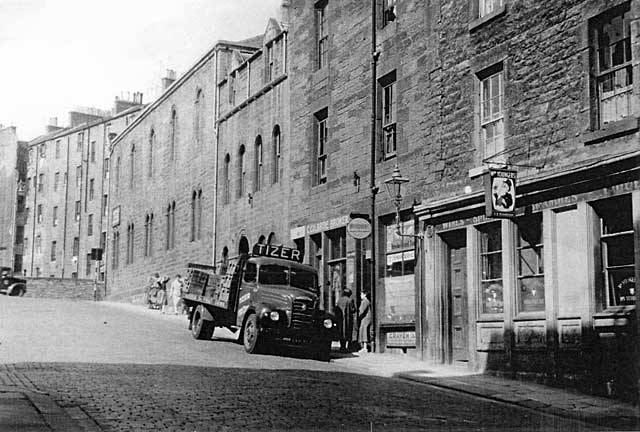
imomusI don't really remember Dumbiedykes, a slummy but charming area at the foot of the dramatic volcanic landscape of Queen's Park, Edinburgh, Scotland. It was demolished when I was 2. But, prompted by an interesting post by ![[livejournal.com profile]](https://www.dreamwidth.org/img/external/lj-userinfo.gif) niddrie_edge, I spent quite a while this morning looking at photos of it on the fascinating EdinPhoto website, which documents my hometown.
niddrie_edge, I spent quite a while this morning looking at photos of it on the fascinating EdinPhoto website, which documents my hometown.

Dumbiedykes was a fairly typical Edinburgh high-density, high-atmosphere tenement district. Looking at pictures now, of course, humdrum details are endlessly evocative: a Direct Supply Carpets lorry sitting in the dreich Edinburgh drizzle, a Tizer lemonade van parked on precipitous Arthur Street outside a William Younger bar. ("McEwan's is the best buy, the best buy in beer!") The stories of people who were there are also fascinating, as they peek into Baxendale's cardboard box factory (you can see its skylights in the top photo here) or steal eggs from a runaway Sunblest bread van.
I didn't really know Dumbiedykes, but I remember watching entire districts of Stockbridge being demolished in the late 1960s, dignified stone terraces full of the kind of atmosphere and spirit of place and community you see here. Just like Dumbiedykes, they were replaced by horrible flimsy structures which haven't stood the test of time well and won't be remembered fondly by anybody. (Had they let the "slums" at Salisbury Square stand, though, the city commissioners might have been amazed to discover that its dramatic setting would have bumped the prices there up to levels way beyond what the likes of me could afford by the turn of the century.)
Looking at these photos, I can't help thinking that my lifetime hasn't just seen the erasure of specific places, but of a certain idea of place itself. It's not just that particular streets and districts have changed their appearance, but that the whole concept of roots, space, place, being and belonging, have exploded. I know they have in my life. I've chosen to live far from the town where I grew up, with people of different cultures and races.
Fishing around for a photograph of Dumbiedykes in my own archives, I found one with a Japanese friend in the foreground. I think that says a great deal about the connections of people to places now. When I go back to Edinburgh now, I'm mostly showing it to Japanese people. I've internalized their expectations and tastes. (Not that I always get those right: in my Edinburgh podcast you can hear how terrified Hisae was on the Salisbury Crags path that overlooks Dumbiedykes.)

Places now live by the perceptions of people from the other side of the world as much as by the perceptions of their own residents, which is why, when I go back to Edinburgh now, I get -- rather than the city I once knew -- "the Edinburgh Experience", a highly self-conscious, cleverly mediated spectral city-shaped self-projection. Hogmanay, the Scottish New Year celebration, for instance, has changed in my lifetime from a bunch of drunk locals kissing strangers on the High Street to a micro-managed spectacle involving live music projected onto giant screens, co-ordinated with computer-controlled firework displays over a city centre cordoned off and tightly controlled by the police. A spectacle designed for, and capable of drawing, people from all over the world. People like me, in other words, net-and-jet people who arrive via airports and whose nostalgia for place is kindled by, and mediated through, websites. People who have an "estimated time of arrival" (ETA) and a "point of presence" (POP) rather than any sort of roots in blood and soil, bricks and mortar.
I don't say we ETA-POP net-and-jet people are bad; this is just the way things are, and the way we are now. Ultimately I wouldn't want a life with roots in Dumbiedykes in exchange for the opportunities I've had to experience -- and feel at home in -- Japan and all the other countries I visit. But it's a pretty big change to have happened in just one lifetime. We didn't just change places, we changed place.
niddrie_edge, I spent quite a while this morning looking at photos of it on the fascinating EdinPhoto website, which documents my hometown. Dumbiedykes was a fairly typical Edinburgh high-density, high-atmosphere tenement district. Looking at pictures now, of course, humdrum details are endlessly evocative: a Direct Supply Carpets lorry sitting in the dreich Edinburgh drizzle, a Tizer lemonade van parked on precipitous Arthur Street outside a William Younger bar. ("McEwan's is the best buy, the best buy in beer!") The stories of people who were there are also fascinating, as they peek into Baxendale's cardboard box factory (you can see its skylights in the top photo here) or steal eggs from a runaway Sunblest bread van.
I didn't really know Dumbiedykes, but I remember watching entire districts of Stockbridge being demolished in the late 1960s, dignified stone terraces full of the kind of atmosphere and spirit of place and community you see here. Just like Dumbiedykes, they were replaced by horrible flimsy structures which haven't stood the test of time well and won't be remembered fondly by anybody. (Had they let the "slums" at Salisbury Square stand, though, the city commissioners might have been amazed to discover that its dramatic setting would have bumped the prices there up to levels way beyond what the likes of me could afford by the turn of the century.)
Looking at these photos, I can't help thinking that my lifetime hasn't just seen the erasure of specific places, but of a certain idea of place itself. It's not just that particular streets and districts have changed their appearance, but that the whole concept of roots, space, place, being and belonging, have exploded. I know they have in my life. I've chosen to live far from the town where I grew up, with people of different cultures and races.
Fishing around for a photograph of Dumbiedykes in my own archives, I found one with a Japanese friend in the foreground. I think that says a great deal about the connections of people to places now. When I go back to Edinburgh now, I'm mostly showing it to Japanese people. I've internalized their expectations and tastes. (Not that I always get those right: in my Edinburgh podcast you can hear how terrified Hisae was on the Salisbury Crags path that overlooks Dumbiedykes.)
Places now live by the perceptions of people from the other side of the world as much as by the perceptions of their own residents, which is why, when I go back to Edinburgh now, I get -- rather than the city I once knew -- "the Edinburgh Experience", a highly self-conscious, cleverly mediated spectral city-shaped self-projection. Hogmanay, the Scottish New Year celebration, for instance, has changed in my lifetime from a bunch of drunk locals kissing strangers on the High Street to a micro-managed spectacle involving live music projected onto giant screens, co-ordinated with computer-controlled firework displays over a city centre cordoned off and tightly controlled by the police. A spectacle designed for, and capable of drawing, people from all over the world. People like me, in other words, net-and-jet people who arrive via airports and whose nostalgia for place is kindled by, and mediated through, websites. People who have an "estimated time of arrival" (ETA) and a "point of presence" (POP) rather than any sort of roots in blood and soil, bricks and mortar.
I don't say we ETA-POP net-and-jet people are bad; this is just the way things are, and the way we are now. Ultimately I wouldn't want a life with roots in Dumbiedykes in exchange for the opportunities I've had to experience -- and feel at home in -- Japan and all the other countries I visit. But it's a pretty big change to have happened in just one lifetime. We didn't just change places, we changed place.
![[identity profile]](https://www.dreamwidth.org/img/silk/identity/openid.png)
(no subject)
Date: 2006-12-11 11:29 am (UTC)People who build real roots in real earth are the ones producing the next generations and the *fabric* of society. I would imagine it would be impossible to do that as an international traveller.
Is it and does that bother you?
(no subject)
Date: 2006-12-11 11:42 am (UTC)(no subject)
Date: 2006-12-11 11:52 am (UTC)(no subject)
Date: 2006-12-11 09:34 pm (UTC)Thomas Scott.
(no subject)
Date: 2006-12-11 12:13 pm (UTC)(no subject)
Date: 2006-12-11 03:15 pm (UTC)What would Alvin Toffler say?
Date: 2006-12-11 04:01 pm (UTC)I don't support global warming!! But I also don't think we should wring our hands over making sure a culture never has to change its precious self.
Re: What would Alvin Toffler say?
Date: 2006-12-11 05:48 pm (UTC)Re: What would Alvin Toffler say?
Date: 2006-12-11 08:50 pm (UTC)Choosing change and having it forced upon you are two very different things. What if a major earthquake decimated every cultural cosmopolitan center on earth, forcing you to adopt a lifestyle yopu would not have chosen for yourself, say, eking a living clamdigging in a small bay town. The "what's so bad about change" clause cuts both ways, you see.
Re: What would Alvin Toffler say?
Date: 2006-12-12 02:17 am (UTC)My feeling is that change is good on its face. People who resist it deserve to have it forced upon them periodically.
<< What if a major earthquake decimated every cultural cosmopolitan center on earth, forcing you to adopt a lifestyle yopu would not have chosen for yourself, say, eking a living clamdigging in a small bay town. >>
I think that would be very exciting. But while clamdigging I'd probably be trying to figure out how to get back to the city, if there was one left.
As for flitting about because one has the resources to flit about, as compared to northern fishermen being forced to move because of climate change, clearly we would have to help them move, much as we help retrain workers whose tasks are made obsolescent by technology.
(no subject)
Date: 2006-12-11 07:09 pm (UTC)slums
Date: 2006-12-11 07:40 pm (UTC)I live in what might be a slum - on a council estate of 4 story blocks in Lambeth - but really it's fine. Probably not good if you have kids, though.
Re: slums
Date: 2006-12-11 07:42 pm (UTC)(no subject)
Date: 2006-12-11 08:50 pm (UTC)There's an argument for saying the shitty 1960s housing has kept the area fairly working-class, demographically, and that inner city areas close to desireable amenities (the Dynamic Earth centre, the Scottish Parliament, Arthur's Seat) never have enough working class people in them. So, er, hurrah!
(no subject)
Date: 2006-12-11 09:16 pm (UTC)What he was indicating was the lack of foresight of city planners who saw fit to demolish an area comprising buildings of potential charm and durability, replacing them instead with ugly mass produced housing units.
In other words doing what successive governments in the U.K. and in Ireland- where I live- have done for decades...demolishing the tenements of poverty, the superficial manifestations of poverty but ignoring the root causes of this poverty.
Thomas Scott.
(no subject)
Date: 2006-12-11 09:21 pm (UTC)slums
Date: 2006-12-11 09:25 pm (UTC)Our flats (I mean the 4 storey blocks in Lambeth) were built in the 30s and are wonderfully designed - very small, but the space well used, and the basic structure is bloody good - some small faults that are easily repaired, but nothing big.
an important factor
Date: 2006-12-11 11:38 pm (UTC)(no subject)
Date: 2006-12-12 12:27 am (UTC)!!!
This type of high-tech controlled and micro-managed spectacle is nowadays happening for/and in every cities' celebrations around the world. Why so would people from all over the world will move just to witness what is already 'domesticating' their home-town?
This is the result of the soon obsolete modernist statist allied and nihilistic dictate that the newer (say Hogmanay Alpha version 10.3.2) is the best eva'…
Don't you see the craaaaaap?
Go down your Berlin street now and kiss any strangers you will encounter (and -not only- your so globalized Nippons freund)
Place
Date: 2006-12-13 07:04 pm (UTC)