Amigurumi: the slime of empathy
Aug. 28th, 2006 10:15 am![[personal profile]](https://www.dreamwidth.org/img/silk/identity/user.png) imomus
imomusYour first thought on seeing one of the Japanese knitted dolls known as amigurumi might be "Aw, so cute! Hey, honey, look at this!" But, increasingly, experts are coming to see these knitted critters as something much more sinister. And it's precisely in their universal appeal that the danger lies.
The word ami comes from the Japanese word for stitch, amimie. Gurumi is an affectionate abbreviation of nuigurumi, a stuffed doll. Put them together and you get "amigurumi". And this year, it's the word on Japan's woolen lips.

In the last few months the amigurumi industry has grown to an astounding 57 trillion yen concern, outstripping even Japan's auto manufacturing sector. But look around the island nation's urban landscapes and you won't find a single amigurumi factory. These creatures are all handmade at home by anonymous crochet fanatics.
With that combination of economic clout and underground manufacture, it's no surprise that the notorious Japanese mafia, the yakuza, has taken an interest in the amigurumi industry. Some commentators believe it's now the sinister crime family who are pulling tight the eye-threads on these adorable teddies and tiny bunnies, using them to spread an ideology of right wing nationalism.
 It's not hard to see why an amigurumi makes the perfect fascist trojan horse. Tapping into our most basic mammalian reflexes, the dolls bypass the rational thought control centers of the human brain, stunning our critical capacities and leaving us gasping "Ah ha ha, so cute!" Within seconds of exposure to an amigurumi, even the most intelligent person can become a dolt or, quite frankly, a blithering idiot.
Social psychologists call this phenomenon "the slime of empathy", and their research reveals that underworld powers are using this "slime" to break down personalities and reconstruct them to order.
Flashcard studies in the lab show that homeless people, millionaires, insurance assessors, quantity surveyors and mortuary slab attendants all have the same basic urge to adopt and protect an amigurumi. Given a chance to keep one, less than 1% of experimental subjects were able to refuse, and once they'd accepted the creatures they became extremely reluctant to separate from, discard or destroy them.
It's of little concern to a bank manager with an amigurumi strapped to his wrist that thousands of his customers are defaulting on their loans or stealing money from cash machines using doctored cards. All he cares about is his brown, fuzzy little bundle of empathy. And although he may be quite unaware that it contains a microphone passing his conversations to crime bigwigs, it's likely that he wouldn't care even if he did know. All that concerns him is whether his woolen sparrow "Tori" is hungry for crumbs, or wants a dust bath.

Even if they don't contain transmitters or other surveillance devices, the amigurumis are often coded to transmit ideology through their forms. Here, for instance, is a two-faced amigurumi which encourages duplicity. Here are two vintage models designed to evoke the days when the Emperor was a god in human form. This doll clearly portrays in a positive light the kind of sexual pervert who hangs around children's parks. This one represents resurgent nationalism by way of sinister folk costume. This one is clearly a wristband surveillance device. This one, a panda whose eyes are below its mouth, can only be the spawn of sinister genetic experiments. This one clearly mocks multiculturalism. And here's one the colour of right wing novelist Mishima's hair at the time of his attempted coup.
Whatever their theme, the brightly-colored dolls quickly become a habit. "The first amigurumi I saw was a shy negro rabbit in a bikini," confessed one addict, who wished to remain anonymous for this article, but is a homosexual. "I was so taken with it I had to track down who had made it... Now Shinobu and I live together and make the dolls in a back room," he told me, adding "Please use a false name for Shinobu in your article, or use his real name wearing a false moustache... Hmm, that's a good idea for a doll."
Further reading: The Rise of Japan's Thought Police (Washington Post)
They Know All About You (The Guardian)
The word ami comes from the Japanese word for stitch, amimie. Gurumi is an affectionate abbreviation of nuigurumi, a stuffed doll. Put them together and you get "amigurumi". And this year, it's the word on Japan's woolen lips.
In the last few months the amigurumi industry has grown to an astounding 57 trillion yen concern, outstripping even Japan's auto manufacturing sector. But look around the island nation's urban landscapes and you won't find a single amigurumi factory. These creatures are all handmade at home by anonymous crochet fanatics.
With that combination of economic clout and underground manufacture, it's no surprise that the notorious Japanese mafia, the yakuza, has taken an interest in the amigurumi industry. Some commentators believe it's now the sinister crime family who are pulling tight the eye-threads on these adorable teddies and tiny bunnies, using them to spread an ideology of right wing nationalism.
It's not hard to see why an amigurumi makes the perfect fascist trojan horse. Tapping into our most basic mammalian reflexes, the dolls bypass the rational thought control centers of the human brain, stunning our critical capacities and leaving us gasping "Ah ha ha, so cute!" Within seconds of exposure to an amigurumi, even the most intelligent person can become a dolt or, quite frankly, a blithering idiot.Social psychologists call this phenomenon "the slime of empathy", and their research reveals that underworld powers are using this "slime" to break down personalities and reconstruct them to order.
Flashcard studies in the lab show that homeless people, millionaires, insurance assessors, quantity surveyors and mortuary slab attendants all have the same basic urge to adopt and protect an amigurumi. Given a chance to keep one, less than 1% of experimental subjects were able to refuse, and once they'd accepted the creatures they became extremely reluctant to separate from, discard or destroy them.
It's of little concern to a bank manager with an amigurumi strapped to his wrist that thousands of his customers are defaulting on their loans or stealing money from cash machines using doctored cards. All he cares about is his brown, fuzzy little bundle of empathy. And although he may be quite unaware that it contains a microphone passing his conversations to crime bigwigs, it's likely that he wouldn't care even if he did know. All that concerns him is whether his woolen sparrow "Tori" is hungry for crumbs, or wants a dust bath.
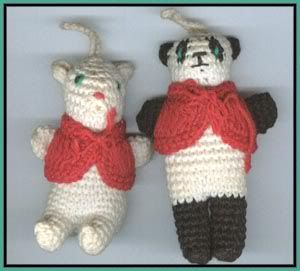
Even if they don't contain transmitters or other surveillance devices, the amigurumis are often coded to transmit ideology through their forms. Here, for instance, is a two-faced amigurumi which encourages duplicity. Here are two vintage models designed to evoke the days when the Emperor was a god in human form. This doll clearly portrays in a positive light the kind of sexual pervert who hangs around children's parks. This one represents resurgent nationalism by way of sinister folk costume. This one is clearly a wristband surveillance device. This one, a panda whose eyes are below its mouth, can only be the spawn of sinister genetic experiments. This one clearly mocks multiculturalism. And here's one the colour of right wing novelist Mishima's hair at the time of his attempted coup.






Whatever their theme, the brightly-colored dolls quickly become a habit. "The first amigurumi I saw was a shy negro rabbit in a bikini," confessed one addict, who wished to remain anonymous for this article, but is a homosexual. "I was so taken with it I had to track down who had made it... Now Shinobu and I live together and make the dolls in a back room," he told me, adding "Please use a false name for Shinobu in your article, or use his real name wearing a false moustache... Hmm, that's a good idea for a doll."
Further reading: The Rise of Japan's Thought Police (Washington Post)
They Know All About You (The Guardian)
(no subject)
Date: 2006-08-29 01:26 am (UTC)I fear that you still depend too much upon literary analysis. For example, instead of finding evidence of actual mafia influence in this field of cultural production and then reporting on that, you are just giving the art a somewhat forced sinister reading. Seems like you are starting from a set philosophical position and then inventing "soft," easily-debatable readings to match pre-ordainned conclusions. I suggest a more inductive approach - although you may not like what you find...
Marxy
(no subject)
Date: 2006-08-29 02:16 am (UTC)E mailing offline -- without the use of the internet -- is an interesting concept. Do you mean old-fashioned snail mail, or something more esoteric, like ouija boards?
I really wish the "sinister things are afoot in Japan" style I'm parodying here were confined to your writings. By some accounts, for instance, there's more "right wing militarism" in Japan (because there are a few little men in little white vans) than there is in all of America's current wars.
Have you read any Chalmers Johnson (http://en.wikipedia.org/wiki/Chalmers_Johnson)? He heads the Japan Policy Research Institute and is a hard-hitting Japanalyst. But he also writes trenchant books criticizing the rightward swing of the US, like The Sorrows of Empire (http://www.amazon.com/gp/product/0805070044/002-6439208-9505632?v=glance&n=283155). I think he's exemplary for that reason; Americans simply cannot examine the tiny right wing storm in Japan's teacup without seeing the veritable hurricane Katrina of the stuff blowing from their own country through the world.
(no subject)
Date: 2006-08-29 04:44 am (UTC)(Bush being the bearer of world nightmares may mean we should concentrate on his dethroning, but does not mean Japan is a place where the rightists won't burn down your house for saying the wrong thing about Yasukuni. These people have a long history that predates the current wave of American aggression. Blaming their newfound sense of urgency on U.S. foreign policy is ahistorical and verges on apology. Before you sarcastically but ultimately sing their praises, they are not even enemies of your enemies. Not like Koizumi or the hard right really gave Bush any sort of hesitance in supporting the Iraq war.)
I have read plenty of Chalmers Johnson, who is one of the first scholars to stand up and say, "Hey, wait a minute - Japan is a pseudo-democracy."
I think he's exemplary
Here are the limits to thinking someone is exemplary on the fact that you read their bio on Wikipedia. You will curse yourself for bringing him up once you actually leave your computer screen and crack open Japan: Who Governs. He's not really on "your team" if you know what I mean. MITI and the Japanese Miracle is the classic book about bureaucratic control of the Japanese economy. He's one of those liberals who think that bad government is bad government everywhere - whether in the U.S. and in Japan. (For the record, I agree with his book Blowback that the U.S. should get rid of their military empire. )
Totally unfun,
Marxy
(no subject)
Date: 2006-08-29 07:11 am (UTC)This is either just very poor reading of my argument or wilful misrepresentation. I never said the Japanese right was the result of the American right. I said that all analysis of right wing menace ought to keep a sense of proportion, and attack it wherever it's found. This is what Chalmers Johnson does, and what I'm calling exemplary. It's what you signally fail to do, apart from the odd mumble when you're cornered about Bush being a "lone madman" or how, "for the record, the US should get rid of their military empire".
Don't you see the absurdity of that? It's like a weatherman, challenged for missing all the important weather events, saying "For the record, there is a huge hurricane making its way up the entire Eastern Seaboard. But let's get back to our coverage of the light breezes that continue to plague disappointing problem town Des Moines, Iowa. These breezes are not what they seem, and ever since I moved here they've been troubling me deeply."
(no subject)
Date: 2006-08-29 07:22 am (UTC)(no subject)
Date: 2006-08-29 08:18 am (UTC)No, no. The right-wing and yakuza in Japan are a perennial, structural threat to Japanese democracy in the same way that the military complex and CIA are threats to democracy in the United States. The latter is obviously a greater threat to the world, but you dismiss the Kato Koicihi firebombing as it is a "random criminal act" instead of fitting into 150 years of right-wing Japanese terrorism (which was in the past, a great threat to Asia). If you believe that Gore would have also gone to war in Iraq in 2003 or that the next U.S. president will continue to pre-emptively attack countries around the world, then yes, American military imperialism is equally unstoppable.
But where you and Johnson differ is your refusal in the last two years of this ongoing debate with me to even once give serious consideration to the fact that maybe an unchecked yakuza presence in the world's second largest economy that directly funds right-wing terrorism to silence civil society and public debate in Japan is a bad thing. As if you have only one slot for "evil" in your head and that the United States as a whole takes up the entire section.
Then think of it this way: do you really want to see Japan turn into a mini-version of American military aggressors? If not, why stay quiet on Abe or poke fun at the idea that the right-wing in Japan is getting more vicious? All the LOHAS girl knitters in the world can't stop Abe from taking power at this point.
Marxy
(no subject)
Date: 2006-08-29 11:12 am (UTC)(no subject)
Date: 2006-08-30 03:29 am (UTC)that's looks like the common unix shell (bash or csh or whatever) which shows that abe is indeed making good use of his OSX.
(no subject)
Date: 2006-08-29 02:35 am (UTC)