Body Week 5: Pieces I never did
Dec. 14th, 2004 10:07 am![[personal profile]](https://www.dreamwidth.org/img/silk/identity/user.png) imomus
imomusIn 25 years of gallery-going I've seen lots of art about bodies. I've lived through the golden age (and some of the golden showers) of performance art, installation art, body art, and video. I even mounted an installation / performance / video show of my own in a New York gallery back in 2000. I could talk about the most extreme things I've seen (Costes scattering piss on the audience and body slamming into us naked, sending all but the most foolhardy to cower at the back of the room or leave), but I want to talk about just one work, the first I ever saw, and the one that might have impressed me most deeply.

In 1979 I was a teenager living in Edinburgh. There weren't many art galleries. In fact, the city's 'art district' consisted of just two, both in the same building perched over Waverley Station: the Fruitmarket Gallery and, upstairs, the smaller New 57 Gallery. The steps up to the New 57 were steep industrial fire escape steps very like the iron steps I'd daily climb twenty years later in New York, heading for my own performance show on 26th Street, Chelsea. Art world posters lined the staircase and provided a transition to a world that seemed much more New York than Edinburgh -- a world hinted at in the Talking Heads records I was devouring at the time, the world of painters, art students and community video makers emerging from songs like 'Stay Hungry', 'Artists Only' and 'Found A Job'.

You never knew, when you climbed those resonant silver-painted iron stairs, what kind of world you'd emerge into. One month it would be a bright, white warren of Polish theatre slogans, another an open display of cool, restrained geometric paintings. You'd usually have the place to yourself; despite being right next to the south exit of Edinburgh's busiest spot, the train station, the gallery seemed to be off-limits to all but a handful of people - secretive, alien, cosmopolitan, advanced, rarefied. So one day I clanged up those steps, wearing my thick blue Chinese army coat and my clumpy brown Doc Martens, to be confronted by a booth installation featuring the video works of an artist called David Critchley. A girl came out of the office and started the video for me, then scurried away.
It was a tape called Pieces I Never Did. Critchley has since destroyed the work, so it exists only in my memory and the memories of those who saw it. One of those people is, I'm pretty sure, David Bowie, because he incorporated one of the tape's tropes into his 1980 album 'Scary Monsters'. Critchley sits facing the camera, describing in an intimate, hesitant, pompous yet embarrassed way all the pieces he'd thought about doing, but never got around to doing, or never raised the money, resources or courage to do, or stopped himself doing for reasons of taste, sanity, decency. He then does the pieces, but intercuts them with himself shouting 'Shut up! Shut up!' in an increasingly strident, desperate, self-censorious tone. (Bowie shouts 'Shut up!' in exactly the same way, as Fripp plays self-indulgent haywire guitar at the end of 'It's No Game (Part 1)' on Scary Monsters, released in September 1980.)

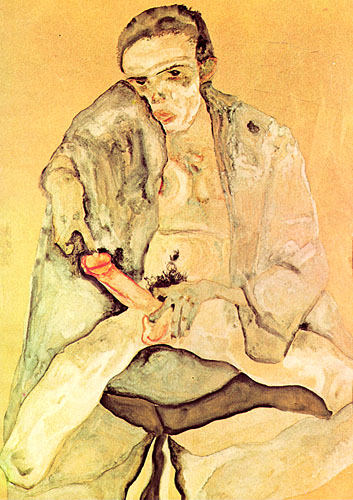
The pieces Critchley 'never did' (at least until he reconstructed their conceptions and abortions in this tape) include a sequence where he 'jumps against a wall without cease until the stucco loosens, each time revealing a bigger part of the brick wall' and a sequence in which he masturbates to climax. Now, I knew that Egon Shiele had made a Self-Portrait Masturbating in Vienna sixty years before (and in fact my hero David Bowie had been touted to play Schiele in a biopic just the year before). Schiele had ended up in prison for his violations of Austrian sexual ethics, but Britain in the 70s was a slightly more tolerant society. I can't say I wasn't shocked, though. I'd only seen one porn film in my entire life, the pretty but totally softcore 'Black Emmanuelle, White Emmanuelle', and there certainly hadn't been any penises in it. So when the gallery girl came back to rewind the tape we avoided each other's eyes. We seemed to share Critchley's shame, the same shame which presumably made him destroy the tape.
I've seen lots of art since then, and I've met much more extreme body artists like Costes and Ron Athey. But I don't think anything is likely to hit me as hard as 'Pieces I Never Did'. The tape seemed to say 'There isn't anything you can't do in art. Even the ideas you don't have the guts or the resources or the strength and stamina to do, you can do.' Perhaps Critchley's tape was a more British, more sexual, more ambiguous and embarrassed, less macho and gun-oriented take on the performances of Chris Burden (another Bowie reference point, since 'Joe The Lion' on 'Heroes' is supposedly about Burden). Personally, I like Critchley's shame and ambivalence a lot more than Burden's hardman dares. If Burden is all about scarification (one of the things 'body art' has come to signify) and mortification of the body, Critchley is interested in its shameful gratification. He parallels Paul McCarthy, perhaps, but his mixed feelings and the intimacy of his presentation makes him attractively vulnerable. I'm sure he crept away from the London Video Arts studio where he made 'Pieces I Never Did' with something of the same sense of interesting shame that I felt as I descended the blue neon-lit silver iron steps of the New 57 Gallery, heading off in the general direction of my recording career.
In 1979 I was a teenager living in Edinburgh. There weren't many art galleries. In fact, the city's 'art district' consisted of just two, both in the same building perched over Waverley Station: the Fruitmarket Gallery and, upstairs, the smaller New 57 Gallery. The steps up to the New 57 were steep industrial fire escape steps very like the iron steps I'd daily climb twenty years later in New York, heading for my own performance show on 26th Street, Chelsea. Art world posters lined the staircase and provided a transition to a world that seemed much more New York than Edinburgh -- a world hinted at in the Talking Heads records I was devouring at the time, the world of painters, art students and community video makers emerging from songs like 'Stay Hungry', 'Artists Only' and 'Found A Job'.
You never knew, when you climbed those resonant silver-painted iron stairs, what kind of world you'd emerge into. One month it would be a bright, white warren of Polish theatre slogans, another an open display of cool, restrained geometric paintings. You'd usually have the place to yourself; despite being right next to the south exit of Edinburgh's busiest spot, the train station, the gallery seemed to be off-limits to all but a handful of people - secretive, alien, cosmopolitan, advanced, rarefied. So one day I clanged up those steps, wearing my thick blue Chinese army coat and my clumpy brown Doc Martens, to be confronted by a booth installation featuring the video works of an artist called David Critchley. A girl came out of the office and started the video for me, then scurried away.
It was a tape called Pieces I Never Did. Critchley has since destroyed the work, so it exists only in my memory and the memories of those who saw it. One of those people is, I'm pretty sure, David Bowie, because he incorporated one of the tape's tropes into his 1980 album 'Scary Monsters'. Critchley sits facing the camera, describing in an intimate, hesitant, pompous yet embarrassed way all the pieces he'd thought about doing, but never got around to doing, or never raised the money, resources or courage to do, or stopped himself doing for reasons of taste, sanity, decency. He then does the pieces, but intercuts them with himself shouting 'Shut up! Shut up!' in an increasingly strident, desperate, self-censorious tone. (Bowie shouts 'Shut up!' in exactly the same way, as Fripp plays self-indulgent haywire guitar at the end of 'It's No Game (Part 1)' on Scary Monsters, released in September 1980.)
The pieces Critchley 'never did' (at least until he reconstructed their conceptions and abortions in this tape) include a sequence where he 'jumps against a wall without cease until the stucco loosens, each time revealing a bigger part of the brick wall' and a sequence in which he masturbates to climax. Now, I knew that Egon Shiele had made a Self-Portrait Masturbating in Vienna sixty years before (and in fact my hero David Bowie had been touted to play Schiele in a biopic just the year before). Schiele had ended up in prison for his violations of Austrian sexual ethics, but Britain in the 70s was a slightly more tolerant society. I can't say I wasn't shocked, though. I'd only seen one porn film in my entire life, the pretty but totally softcore 'Black Emmanuelle, White Emmanuelle', and there certainly hadn't been any penises in it. So when the gallery girl came back to rewind the tape we avoided each other's eyes. We seemed to share Critchley's shame, the same shame which presumably made him destroy the tape.
I've seen lots of art since then, and I've met much more extreme body artists like Costes and Ron Athey. But I don't think anything is likely to hit me as hard as 'Pieces I Never Did'. The tape seemed to say 'There isn't anything you can't do in art. Even the ideas you don't have the guts or the resources or the strength and stamina to do, you can do.' Perhaps Critchley's tape was a more British, more sexual, more ambiguous and embarrassed, less macho and gun-oriented take on the performances of Chris Burden (another Bowie reference point, since 'Joe The Lion' on 'Heroes' is supposedly about Burden). Personally, I like Critchley's shame and ambivalence a lot more than Burden's hardman dares. If Burden is all about scarification (one of the things 'body art' has come to signify) and mortification of the body, Critchley is interested in its shameful gratification. He parallels Paul McCarthy, perhaps, but his mixed feelings and the intimacy of his presentation makes him attractively vulnerable. I'm sure he crept away from the London Video Arts studio where he made 'Pieces I Never Did' with something of the same sense of interesting shame that I felt as I descended the blue neon-lit silver iron steps of the New 57 Gallery, heading off in the general direction of my recording career.
![[identity profile]](https://www.dreamwidth.org/img/silk/identity/openid.png)
(no subject)
Date: 2004-12-15 12:07 am (UTC)I'm sure the problem here is that I'm just not well educated about art, but I'd like to think that what little I do know would get me somewhere in puzzling out the artist's intent.
(no subject)
Date: 2004-12-15 08:37 am (UTC)- After all these years, it's the masturbation scene that I remember best.
- The device of shouting 'Shut up! Shut up!' is at its most powerful during the masturbation scene, because of the secrecy and shame associated with masturbation.
- This was the scene in which I felt that 'work was being done at a border' -- and something art does very valuably is cross borders, or transgress.
- The reference to Schiele was there for me, but perhaps it was also really a reference to Vito Acconci, which I wouldn't have picked up at the time.
- Without that scene, it's unlikely I would have thought 'In art, anything is possible'.
(no subject)
Date: 2004-12-16 01:31 am (UTC)I didn't twig that the "Shut up! Shut up!" was part of that scene as well, and to me that changes everything. The rest of your observations are interesting as well. The Schiele reference makes me think: I have no trouble with the idea of a masturbation painting, why then a video? Maybe it's that videos of oneself masturbating are easy to come by (rimshot please) these days in other contexts -- which of course says nothing about how the original piece felt to produce and consider exhibiting at the time it was done.
But also there's an idea (just mine, perhaps, and not necessarily a sound one, just the one I observe on introspection) that a still image feels more artistically (because aesthetically) significant than a series of moving images, and the significance decreases as the narrative coherence and naturalism of the moving images increases. It begins to seem less art and more film, and when it's an isolated scene it's in a particularly odd space. Something to do with the amount of information in it?
In addition to crossing boundaries art is also great for raising questions, and it looks like this piece has accomplished that ably without me ever having to see it!