Citizen student
Feb. 25th, 2009 02:50 pm![[personal profile]](https://www.dreamwidth.org/img/silk/identity/user.png) imomus
imomusThe photo below (Anja Niedringhaus, AP) shows a classroom in Jebaliya, Gaza. The name cards represent pupils of the Fakhoura School killed by Israeli army shells last month.

But Israel's actions in Gaza have affected classrooms elsewhere. "We are a group of students concerned about the university's continuing support for Israel's actions in Gaza and the West Bank," University of Plymouth students say on their occupation blog, "indicated by the university's investments with BAE Systems who have sold 236 F-16 fighter planes to the Israeli state, and its silence over the recent atrocities and human rights abuses perpetrated by Israel in the Gaza Strip."
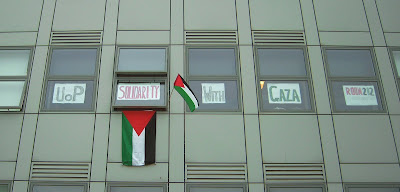
"As a result we have occupied room 202 in the Smeaton Building in solidarity with the people of Palestine and to directly protest against the university's complicity in Israeli war crimes.... The occupying students would be keen for lectures to continue in this room without interruption. We are willing for a small group to remain unobtrusively at the back of the room, as a symbolic presence."
Cue obligatory flip references to Citizen Smith, the counter-revolutionary UK sitcom from 1977 in which "a young Marxist urban revolutionary living in Tooting, South London, is attempting to emulate his hero Che Guevara. Wolfie is the self-proclaimed leader of the Tooting Popular Front (in reality a small bunch of his friends) the goals of which are "Power to the People" and "Freedom for Tooting". In reality, he is an unemployed dreamer and petty criminal whose plans fall through due to laziness and disorganisation."
But in this case it isn't just a "small bunch of friends". The UK, over the past month, has seen an extraordinary (and under-reported, though The Guardian did post an article) series of student occupations. There are or have been occupations at Edinburgh, Glasgow, Goldsmiths, Sheffield, the University of East Anglia, Cambridge, Bradford, the London School of Economics, Queen Mary, King's College, SOAS, Byam Shaw and Leeds, each with its own occupation blog (click the links for heartening photos of "revolting students" strumming guitars, preparing vegan food, picketing, pamphleteering and generally acting as if it were 1968 all over again).

Many students have been demanding -- and getting -- scholarships at their universities for Palestinian students; another way classrooms in Gaza and classrooms in the UK are now being linked, and a vindication of the occupations in itself. In some colleges the protests have widened into issues about budget cuts and a streamlined "Education PLC" attitude.
The Gaza shelling may now be over but, as Israeli newspaper Haaretz reports today, many (including Hillary Clinton) are extremely frustrated by the attitude of the Israeli authorities to the humanitarian crisis in Gaza:
"When Senator John Kerry visited the Strip, he learned that many trucks loaded with pasta were not permitted in. When the chairman of the Senate Foreign Affairs Committee inquired as to the reason for the delay, he was told by United Nations aid officials that "Israel does not define pasta as part of humanitarian aid - only rice shipments." Kerry asked Barak about the logic behind this restriction, and only after the senior U.S. official's intervention did the defense minister allow the pasta into the Strip. The U.S. senator updated colleagues at the Senate and other senior officials in Washington of the details of his visit.
"The issue of humanitarian aid is central to a major debate between Israel's foreign and defense ministries. The former supports broadening the amount and types of aid, while the defense ministry opposes anything it considers "concessions" to Hamas. A senior source dealing with humanitarian aid issues on the Israeli side said that Gilad has prepared a list of "humanitarian aid items" and refuses to broaden it. "Authority is in the hands of one person, and he is not willing to help," the source said. "This is outrageous. Why should a senior American official issue a protest on pasta in order for us to recognize that we need to allow it into the Gaza Strip?"
But Israel's actions in Gaza have affected classrooms elsewhere. "We are a group of students concerned about the university's continuing support for Israel's actions in Gaza and the West Bank," University of Plymouth students say on their occupation blog, "indicated by the university's investments with BAE Systems who have sold 236 F-16 fighter planes to the Israeli state, and its silence over the recent atrocities and human rights abuses perpetrated by Israel in the Gaza Strip."
"As a result we have occupied room 202 in the Smeaton Building in solidarity with the people of Palestine and to directly protest against the university's complicity in Israeli war crimes.... The occupying students would be keen for lectures to continue in this room without interruption. We are willing for a small group to remain unobtrusively at the back of the room, as a symbolic presence."
Cue obligatory flip references to Citizen Smith, the counter-revolutionary UK sitcom from 1977 in which "a young Marxist urban revolutionary living in Tooting, South London, is attempting to emulate his hero Che Guevara. Wolfie is the self-proclaimed leader of the Tooting Popular Front (in reality a small bunch of his friends) the goals of which are "Power to the People" and "Freedom for Tooting". In reality, he is an unemployed dreamer and petty criminal whose plans fall through due to laziness and disorganisation."
But in this case it isn't just a "small bunch of friends". The UK, over the past month, has seen an extraordinary (and under-reported, though The Guardian did post an article) series of student occupations. There are or have been occupations at Edinburgh, Glasgow, Goldsmiths, Sheffield, the University of East Anglia, Cambridge, Bradford, the London School of Economics, Queen Mary, King's College, SOAS, Byam Shaw and Leeds, each with its own occupation blog (click the links for heartening photos of "revolting students" strumming guitars, preparing vegan food, picketing, pamphleteering and generally acting as if it were 1968 all over again).
Many students have been demanding -- and getting -- scholarships at their universities for Palestinian students; another way classrooms in Gaza and classrooms in the UK are now being linked, and a vindication of the occupations in itself. In some colleges the protests have widened into issues about budget cuts and a streamlined "Education PLC" attitude.
The Gaza shelling may now be over but, as Israeli newspaper Haaretz reports today, many (including Hillary Clinton) are extremely frustrated by the attitude of the Israeli authorities to the humanitarian crisis in Gaza:
"When Senator John Kerry visited the Strip, he learned that many trucks loaded with pasta were not permitted in. When the chairman of the Senate Foreign Affairs Committee inquired as to the reason for the delay, he was told by United Nations aid officials that "Israel does not define pasta as part of humanitarian aid - only rice shipments." Kerry asked Barak about the logic behind this restriction, and only after the senior U.S. official's intervention did the defense minister allow the pasta into the Strip. The U.S. senator updated colleagues at the Senate and other senior officials in Washington of the details of his visit.
"The issue of humanitarian aid is central to a major debate between Israel's foreign and defense ministries. The former supports broadening the amount and types of aid, while the defense ministry opposes anything it considers "concessions" to Hamas. A senior source dealing with humanitarian aid issues on the Israeli side said that Gilad has prepared a list of "humanitarian aid items" and refuses to broaden it. "Authority is in the hands of one person, and he is not willing to help," the source said. "This is outrageous. Why should a senior American official issue a protest on pasta in order for us to recognize that we need to allow it into the Gaza Strip?"
read this
Date: 2009-03-23 10:22 pm (UTC)your hypocrisy makes me sick
Date: 2009-03-26 03:54 pm (UTC)New support for West Bank outpost
By Tim Franks
BBC News, Jerusalem
The road to the outpost is being built on privately owned Palestinian land
An unauthorised Jewish settlement in the West Bank, illegal even under Israeli law, appears to benefiting from state funding, the BBC has uncovered.
A road is being built from the established settlement of Eli, near the Palestinian city of Nablus, leading east to the illegal outpost at Hayovel.
Settlement expansion is a major barrier to an Israeli-Palestinian peace deal.
The international community regards all settlements in the West Bank as illegal under international law.
Israel disputes this, but even under Israeli law, those newer, smaller settlements - known as outposts - which have not received authorisation from the government are deemed, by the Israeli government, to be illegal.
Outpost promise
Drive up the twisting, landscaped roads of Eli, a mid-sized settlement in the heart of the West Bank, and you come across a scene of intense construction activity. Lorries, tractors, and graders are digging, laying and smoothing a new road, more than a kilometre long. The road leads east to the outpost of Hayovel.
The road-building is not difficult to spot. But outside observers are not welcome. The BBC was asked, twice, to leave the settlement, when we drew too close to the site of the road.
Since the publication of a government-commissioned report into outposts, four years ago, they were supposed not to receive any further support from the authorities.
Indeed, the outgoing Israeli government promised to start dismantling the existing outposts.
That did not happen. Late last year, however, after an increase in violence from a minority of settlers, aimed at Israeli security forces, the cabinet announced an absolute cut-off in all public funding to the outposts.
The new road suggests that the reality is otherwise.
'Security measure'
A 10-minute drive away, from Eli, four Palestinian villagers are clambering their way around an earth mound which is blocking their route by car.
The mound has been placed by the Israeli army for, it says, security reasons.
For Abdel Nasser, a civil servant with a job in Ramallah, there is a double bind. Not only is his journey to work almost double the length it used to be - 43 rather than 22 kilometres. But, as he shows on a map, the new road to the outpost carves straight through land which he says is owned by his village, Qaryut.
"The settlers took this land," he says, "maybe 5,000 dunams (500 hectares). They opened the road between Eli and Hayovel one month ago. It's private land, owned by our people."
Enlarge Image
On his map, the road is marked by a red line. It cuts directly through a patch of green land. The significance of that colour is that it is the shading the Israeli authorities themselves use to indicate land which they regard as privately owned by Palestinians.
Mr Nasser says that neither he nor anyone else in his village has sold the land, or received a military seizure order.
The BBC asked the relevant government and military departments why this road was being built on what their own map indicates is privately owned Palestinian land; and how this road tallied with the government policy of no public funding going towards outposts.
No-one was able to provide the BBC with an answer. However, in a fax to the Israeli human rights group, Yesh Din, which has been investigating the issue of the road on behalf of the Palestinian villagers, an official from Israel's Civil Administration said that the matter was now in the hands of "inspectors".
Abdul Nasser says his journey to work has almost doubled
For Dror Etkes, the veteran investigator who works for Yesh Din, the answer is simple enough.
The reason for the road-building, he says, is because of the "tragic" gap between what the government says and what it does.