The uncanny valley
Oct. 12th, 2004 09:51 am![[personal profile]](https://www.dreamwidth.org/img/silk/identity/user.png) imomus
imomusToday's thought follows on from something that came up yesterday, when I was thinking about the radio series The Pond. I like the fact that the series avoids anthropomorphism -- it 'doubles strangeness' rather than halving it in the manner of, say, 'A Bug's Life', which sugars the pill of insects' uncanny difference from us by assimilating them to human stereotypes. The Pond uses 'genre splicing' (a time structure splicing biological seasons and historical eras) to double the strangeness of the pond and plunge us, pleasurably, into two 'uncanny' forms of otherness -- alien species and other times.

But I began to wonder about my own presuppositions. Does genre splicing necessarily result in 'double strangeness'? Mightn't putting two cliched generic approaches together just result in double the number of cliches? I criticized the makers of 'A Bug's Life' for anthropomorphism -- for making beetles human -- then compared a beetle to Sisyphus! So is anthropomorphism a good or bad thing to do? Is it bad when others do it in a populist way, but good when I do it with reference to a Greek myth? And isn't anthropomorphism a kind of 'genre splicing' too? When we show an animal that acts like a human, we're, in a sense, both genre splicing and gene splicing. Perhaps 'A Bug's Life' doesn't aim for or achieve the kind of strangeness that would shake us into a new perceptual mode which would allow us to see -- and respect -- the uncanniness of everything. Nevertheless anthropomorphism -- defined as the mixing of man and beast in one character, rather than simply assimilating animals to human-like forms -- has great potential for doubling rather than halving strangeness. Look at Ovid, look at Matthew Barney.
But actually, anthropomorphism is all about assimilating animals (and gods) to human form. It's about reducing strangeness rather than respecting it. Perhaps we need another word for mixing man and beast in one character in a way that doubles strangeness. Following Kafka, maybe we should call that 'metaphorphosis'. Anthropomorphism halves strangeness, metamorphosis doubles it.
Googling definitions of anthropomorphism, I discovered a Wikipedia article on a fascinating phenomenon known as the Uncanny Valley:
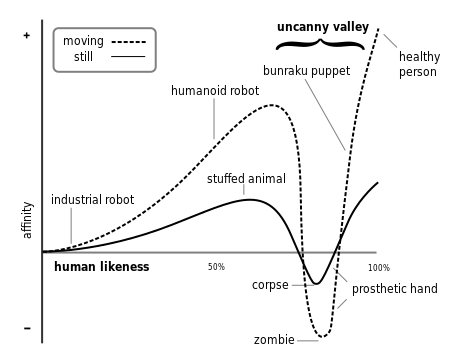
'The Uncanny Valley is a principle of robotics concerning the emotional response of humans to robots and other non-human entities. It was theorized by Japanese roboticist Masahiro Mori in the late 1970s through psychological experiments in which he measured human response to robots of varying degrees of anthropomorphism.
'This principle states that as a robot is made more humanlike in its appearance and motion, the emotional response of a human being to the robot will become increasingly positive and empathetic, until a point is reached at which the response suddenly becomes strongly repulsive. Thenceforth, as the appearance and motion are made to be indistinguishable to that of a human being, the emotional response becomes positive once more and approaches human-human empathy levels.'
Okay, that curve sort of makes sense. We like ourselves, and we like our dogs, but we don't like our fellow humans. At least, that's what the Scots say about the English.
Wikipedia again: 'This gap of repulsive response aroused by a robot with appearance and motion between a "barely-human" and "fully human" entity is called the Uncanny Valley. The name harkens to the notion that a robot which is "almost human" will seem overly "strange" to a human being and thus will fail to evoke the requisite empathetic response required for productive human-robot interaction.
'The phenomenon can be explained by the notion that if an entity is sufficiently non-humanlike, then the humanlike characteristics will tend to stand out and be noticed easily, generating empathy. On the other hand, if the entity is "almost human", then the non-human characteristics will be the ones that stand out, leading to a feeling of "strangeness" in the human viewer.'

Ah, now that's beginning to work for me in other ways. 'The darkest hour is just before dawn', and the almost-human is the least human. Being a literary sort of guy, I'm also tempted to plot the uncanny valley to the gap that divides simile from metaphor, the gap between like and is. We're comfortable saying a photograph is 'like' us. We're comfortable saying a mirror image 'is' us. But something that's both photo and mirror (like a live video image of ourselves we glimpse in a TV shop window) exists in the uncanny gap between simile and metaphor, and can sometimes horrify us as a result.
The Uncanny Valley idea also chimes with Freud's narcissism of minor differences ('the phenomenon that it is precisely communities with adjoining territories, and related to each other in other ways as well, who are engaged in constant feuds and in ridiculing each other'), or Derrida's strategic valorisation of the suppressed supplementary term of any binary.
Wikipedia continues: 'Although originally applied only to robotics, the principle has been applied to computer-animation characters. The Uncanny Valley was considered by some to be the reason behind the difficulty in creating computer-animated characters. The principle leads to the conclusion that to generate a positive emotional response in human beings, it is often better to include fewer human characteristics in the entity, lest it fall into the Uncanny Valley.'
This assumes that we as storytellers want to avoid the uncanny and encourage empathy. But what if we want to evoke it? What, in other words, if we're into Brecht rather than Method, into alienation rather than identification, into defamiliarization rather than familiarization, ostranenie rather than repetition?
The place where the 'credibility gap' or the 'uncanny valley' occurs is not at the point furthest from the truth, but at the point closest to it. When something is almost credible, it lacks credibility. When it's completely incredible, it has an odd sort of believability. Perhaps this explains the idea that someone like John Kerry, famously decorated for bravery, can be rubbished for cowardice, whereas Bush, who everybody knows skived off his military service, can seem 'brave' and 'resolute' to many. Once a thesis gets overstated, the antithesis has a tendency to rush in, even if the truth lies closer to the thesis than the antithesis.
If, plunged deep into the Uncanny Valley, it's easy to see the other as truly other rather than as a version of oneself, perhaps we can overcome aversion? It's often suggested that a world in which we are 'all brothers' and 'live as one' would be a world without killing. That may be true, if the unity is total. But if we miss that goal and simply achieve a world of 'minor differences', we're in trouble. I believe that divergence, not convergence, is the answer. We need to value our differences from other people, not our similarities to them. 'Double strangeness' might be the way out of the murderous narcissism of minor differences. Perhaps, with the help of the uncanny, 'ape shall never kill ape'.
But I began to wonder about my own presuppositions. Does genre splicing necessarily result in 'double strangeness'? Mightn't putting two cliched generic approaches together just result in double the number of cliches? I criticized the makers of 'A Bug's Life' for anthropomorphism -- for making beetles human -- then compared a beetle to Sisyphus! So is anthropomorphism a good or bad thing to do? Is it bad when others do it in a populist way, but good when I do it with reference to a Greek myth? And isn't anthropomorphism a kind of 'genre splicing' too? When we show an animal that acts like a human, we're, in a sense, both genre splicing and gene splicing. Perhaps 'A Bug's Life' doesn't aim for or achieve the kind of strangeness that would shake us into a new perceptual mode which would allow us to see -- and respect -- the uncanniness of everything. Nevertheless anthropomorphism -- defined as the mixing of man and beast in one character, rather than simply assimilating animals to human-like forms -- has great potential for doubling rather than halving strangeness. Look at Ovid, look at Matthew Barney.
But actually, anthropomorphism is all about assimilating animals (and gods) to human form. It's about reducing strangeness rather than respecting it. Perhaps we need another word for mixing man and beast in one character in a way that doubles strangeness. Following Kafka, maybe we should call that 'metaphorphosis'. Anthropomorphism halves strangeness, metamorphosis doubles it.
Googling definitions of anthropomorphism, I discovered a Wikipedia article on a fascinating phenomenon known as the Uncanny Valley:
'The Uncanny Valley is a principle of robotics concerning the emotional response of humans to robots and other non-human entities. It was theorized by Japanese roboticist Masahiro Mori in the late 1970s through psychological experiments in which he measured human response to robots of varying degrees of anthropomorphism.
'This principle states that as a robot is made more humanlike in its appearance and motion, the emotional response of a human being to the robot will become increasingly positive and empathetic, until a point is reached at which the response suddenly becomes strongly repulsive. Thenceforth, as the appearance and motion are made to be indistinguishable to that of a human being, the emotional response becomes positive once more and approaches human-human empathy levels.'
Okay, that curve sort of makes sense. We like ourselves, and we like our dogs, but we don't like our fellow humans. At least, that's what the Scots say about the English.
Wikipedia again: 'This gap of repulsive response aroused by a robot with appearance and motion between a "barely-human" and "fully human" entity is called the Uncanny Valley. The name harkens to the notion that a robot which is "almost human" will seem overly "strange" to a human being and thus will fail to evoke the requisite empathetic response required for productive human-robot interaction.
'The phenomenon can be explained by the notion that if an entity is sufficiently non-humanlike, then the humanlike characteristics will tend to stand out and be noticed easily, generating empathy. On the other hand, if the entity is "almost human", then the non-human characteristics will be the ones that stand out, leading to a feeling of "strangeness" in the human viewer.'
Ah, now that's beginning to work for me in other ways. 'The darkest hour is just before dawn', and the almost-human is the least human. Being a literary sort of guy, I'm also tempted to plot the uncanny valley to the gap that divides simile from metaphor, the gap between like and is. We're comfortable saying a photograph is 'like' us. We're comfortable saying a mirror image 'is' us. But something that's both photo and mirror (like a live video image of ourselves we glimpse in a TV shop window) exists in the uncanny gap between simile and metaphor, and can sometimes horrify us as a result.
The Uncanny Valley idea also chimes with Freud's narcissism of minor differences ('the phenomenon that it is precisely communities with adjoining territories, and related to each other in other ways as well, who are engaged in constant feuds and in ridiculing each other'), or Derrida's strategic valorisation of the suppressed supplementary term of any binary.
Wikipedia continues: 'Although originally applied only to robotics, the principle has been applied to computer-animation characters. The Uncanny Valley was considered by some to be the reason behind the difficulty in creating computer-animated characters. The principle leads to the conclusion that to generate a positive emotional response in human beings, it is often better to include fewer human characteristics in the entity, lest it fall into the Uncanny Valley.'
This assumes that we as storytellers want to avoid the uncanny and encourage empathy. But what if we want to evoke it? What, in other words, if we're into Brecht rather than Method, into alienation rather than identification, into defamiliarization rather than familiarization, ostranenie rather than repetition?
The place where the 'credibility gap' or the 'uncanny valley' occurs is not at the point furthest from the truth, but at the point closest to it. When something is almost credible, it lacks credibility. When it's completely incredible, it has an odd sort of believability. Perhaps this explains the idea that someone like John Kerry, famously decorated for bravery, can be rubbished for cowardice, whereas Bush, who everybody knows skived off his military service, can seem 'brave' and 'resolute' to many. Once a thesis gets overstated, the antithesis has a tendency to rush in, even if the truth lies closer to the thesis than the antithesis.
If, plunged deep into the Uncanny Valley, it's easy to see the other as truly other rather than as a version of oneself, perhaps we can overcome aversion? It's often suggested that a world in which we are 'all brothers' and 'live as one' would be a world without killing. That may be true, if the unity is total. But if we miss that goal and simply achieve a world of 'minor differences', we're in trouble. I believe that divergence, not convergence, is the answer. We need to value our differences from other people, not our similarities to them. 'Double strangeness' might be the way out of the murderous narcissism of minor differences. Perhaps, with the help of the uncanny, 'ape shall never kill ape'.
![[identity profile]](https://www.dreamwidth.org/img/silk/identity/openid.png)
(no subject)
Date: 2004-10-13 12:26 am (UTC)Bravo, and thank you. Many juicy concepts here, and good information.
As you point out, perhaps once a robot seems largely human, it triggers the common feeling of aversion that many have for their fellow man. I think that most people are not accustomed to thinking in terms of more than 'utlanning' or 'framling', so if something comes along that seems mostly human but still throws a lot of curve balls, they jump straight to 'varelse', eg. from "Speaker for the Dead" to "Dawn of the Dead". "It's gonna get me!!"
*****************ObExplanatoryNote***********************
A fictional Nordic philosopher in Orson Scott Card's "Ender" series described gradations of relation called the Hierarchy of Exclusion, roughly as follows: (and yes, I know Card has some sucky political beliefs, but don't throw away the good bits with the rubbish or the bad guys win).
(no subject)
Date: 2004-10-13 03:18 am (UTC)What book is this in, BTW? I've only read Ender's Game (in the not-too-great Swedish translation), and I admit it was many years ago, but I don't remember this...
(no subject)
Date: 2004-10-13 04:02 am (UTC)(no subject)
Date: 2004-10-13 12:49 pm (UTC)There is of course a point where things become repulsive or a threat, though looking at that graph, I can see how a plot can make that shape though though I'd tend to think the transitional areas are only byproducts of connecting the dots. It's a gut reaction to a threat or undesirability that causes that dip.
I guess one could do a hybrid, like the bear character (which by the way I didn't see any of in Japan when I was there in August), you have elements of cute and what might be a turn off to some but amusing to others in one location and let them average out.
When it comes to mixing for that "double strangeness" I think it's all boils down to interaction or lack of it, the old sum of the parts versus just a heap of parts result.
The issue of the doppelganger seems to come into play, it is interesting to connect it in. I see the whole evil twin thing as one of threat and competition. The greatest fear is that the evil twin will replace you and life will go on. It does work well with theories on the threats of computer animation (and sampling in music). It's even more a threat if the doppelganger does the mundane. The fantastic usually overrides any fears and replaces them with wonder if it's sufficiently fantastic.
There's a very interesting and brilliantly wordless Japanese CGI anime series, "Stain of Junk Alley" ("Garakuta dohri no Stain") by Ryuji Masuda centered around a homeless artist character who watches a woman in a nearby apartment. There is even an episode where the main character creates an idealized sculpture of himself and then lives the nightmare of it coming to life and fulfilling his dreams of romancing his dream girl leaving him out in the cold.
It is very interesting how a number of phenomena seem to be linked somehow, though could it just be that some phenomena result in others and some override the effects other factors have - several concurrent phenomena rather than a single one. I only see discrete situations and human reactions to them, I'm not so sure about any continuous transition shown on the graph though perhaps it's worth exploring.
From a purely technical standpoint, substituting cute human-traited bugs for human characters is probably the most advantageous choice possible to pull off because we expect the characters to have hard rigid bodies, no hair or flesh to simulate, yet insects move. The characters for these films are for the most part being chosen in the order in which they can technically be realized more or less well. First toys (plastic), insects, dinosaurs, fish and amusingly often more than one company does the same character choice. (My graduate school classmate and a mutual teacher co-directed "Ice Age" (furry animals) and next year's "Robots" CGI features- in which the characters are made of household appliances forming humanoid shapes.
-nicholas d. kent