The uncanny valley
Oct. 12th, 2004 09:51 am![[personal profile]](https://www.dreamwidth.org/img/silk/identity/user.png) imomus
imomusToday's thought follows on from something that came up yesterday, when I was thinking about the radio series The Pond. I like the fact that the series avoids anthropomorphism -- it 'doubles strangeness' rather than halving it in the manner of, say, 'A Bug's Life', which sugars the pill of insects' uncanny difference from us by assimilating them to human stereotypes. The Pond uses 'genre splicing' (a time structure splicing biological seasons and historical eras) to double the strangeness of the pond and plunge us, pleasurably, into two 'uncanny' forms of otherness -- alien species and other times.

But I began to wonder about my own presuppositions. Does genre splicing necessarily result in 'double strangeness'? Mightn't putting two cliched generic approaches together just result in double the number of cliches? I criticized the makers of 'A Bug's Life' for anthropomorphism -- for making beetles human -- then compared a beetle to Sisyphus! So is anthropomorphism a good or bad thing to do? Is it bad when others do it in a populist way, but good when I do it with reference to a Greek myth? And isn't anthropomorphism a kind of 'genre splicing' too? When we show an animal that acts like a human, we're, in a sense, both genre splicing and gene splicing. Perhaps 'A Bug's Life' doesn't aim for or achieve the kind of strangeness that would shake us into a new perceptual mode which would allow us to see -- and respect -- the uncanniness of everything. Nevertheless anthropomorphism -- defined as the mixing of man and beast in one character, rather than simply assimilating animals to human-like forms -- has great potential for doubling rather than halving strangeness. Look at Ovid, look at Matthew Barney.
But actually, anthropomorphism is all about assimilating animals (and gods) to human form. It's about reducing strangeness rather than respecting it. Perhaps we need another word for mixing man and beast in one character in a way that doubles strangeness. Following Kafka, maybe we should call that 'metaphorphosis'. Anthropomorphism halves strangeness, metamorphosis doubles it.
Googling definitions of anthropomorphism, I discovered a Wikipedia article on a fascinating phenomenon known as the Uncanny Valley:
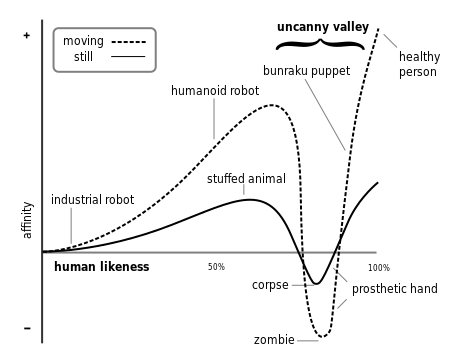
'The Uncanny Valley is a principle of robotics concerning the emotional response of humans to robots and other non-human entities. It was theorized by Japanese roboticist Masahiro Mori in the late 1970s through psychological experiments in which he measured human response to robots of varying degrees of anthropomorphism.
'This principle states that as a robot is made more humanlike in its appearance and motion, the emotional response of a human being to the robot will become increasingly positive and empathetic, until a point is reached at which the response suddenly becomes strongly repulsive. Thenceforth, as the appearance and motion are made to be indistinguishable to that of a human being, the emotional response becomes positive once more and approaches human-human empathy levels.'
Okay, that curve sort of makes sense. We like ourselves, and we like our dogs, but we don't like our fellow humans. At least, that's what the Scots say about the English.
Wikipedia again: 'This gap of repulsive response aroused by a robot with appearance and motion between a "barely-human" and "fully human" entity is called the Uncanny Valley. The name harkens to the notion that a robot which is "almost human" will seem overly "strange" to a human being and thus will fail to evoke the requisite empathetic response required for productive human-robot interaction.
'The phenomenon can be explained by the notion that if an entity is sufficiently non-humanlike, then the humanlike characteristics will tend to stand out and be noticed easily, generating empathy. On the other hand, if the entity is "almost human", then the non-human characteristics will be the ones that stand out, leading to a feeling of "strangeness" in the human viewer.'

Ah, now that's beginning to work for me in other ways. 'The darkest hour is just before dawn', and the almost-human is the least human. Being a literary sort of guy, I'm also tempted to plot the uncanny valley to the gap that divides simile from metaphor, the gap between like and is. We're comfortable saying a photograph is 'like' us. We're comfortable saying a mirror image 'is' us. But something that's both photo and mirror (like a live video image of ourselves we glimpse in a TV shop window) exists in the uncanny gap between simile and metaphor, and can sometimes horrify us as a result.
The Uncanny Valley idea also chimes with Freud's narcissism of minor differences ('the phenomenon that it is precisely communities with adjoining territories, and related to each other in other ways as well, who are engaged in constant feuds and in ridiculing each other'), or Derrida's strategic valorisation of the suppressed supplementary term of any binary.
Wikipedia continues: 'Although originally applied only to robotics, the principle has been applied to computer-animation characters. The Uncanny Valley was considered by some to be the reason behind the difficulty in creating computer-animated characters. The principle leads to the conclusion that to generate a positive emotional response in human beings, it is often better to include fewer human characteristics in the entity, lest it fall into the Uncanny Valley.'
This assumes that we as storytellers want to avoid the uncanny and encourage empathy. But what if we want to evoke it? What, in other words, if we're into Brecht rather than Method, into alienation rather than identification, into defamiliarization rather than familiarization, ostranenie rather than repetition?
The place where the 'credibility gap' or the 'uncanny valley' occurs is not at the point furthest from the truth, but at the point closest to it. When something is almost credible, it lacks credibility. When it's completely incredible, it has an odd sort of believability. Perhaps this explains the idea that someone like John Kerry, famously decorated for bravery, can be rubbished for cowardice, whereas Bush, who everybody knows skived off his military service, can seem 'brave' and 'resolute' to many. Once a thesis gets overstated, the antithesis has a tendency to rush in, even if the truth lies closer to the thesis than the antithesis.
If, plunged deep into the Uncanny Valley, it's easy to see the other as truly other rather than as a version of oneself, perhaps we can overcome aversion? It's often suggested that a world in which we are 'all brothers' and 'live as one' would be a world without killing. That may be true, if the unity is total. But if we miss that goal and simply achieve a world of 'minor differences', we're in trouble. I believe that divergence, not convergence, is the answer. We need to value our differences from other people, not our similarities to them. 'Double strangeness' might be the way out of the murderous narcissism of minor differences. Perhaps, with the help of the uncanny, 'ape shall never kill ape'.
But I began to wonder about my own presuppositions. Does genre splicing necessarily result in 'double strangeness'? Mightn't putting two cliched generic approaches together just result in double the number of cliches? I criticized the makers of 'A Bug's Life' for anthropomorphism -- for making beetles human -- then compared a beetle to Sisyphus! So is anthropomorphism a good or bad thing to do? Is it bad when others do it in a populist way, but good when I do it with reference to a Greek myth? And isn't anthropomorphism a kind of 'genre splicing' too? When we show an animal that acts like a human, we're, in a sense, both genre splicing and gene splicing. Perhaps 'A Bug's Life' doesn't aim for or achieve the kind of strangeness that would shake us into a new perceptual mode which would allow us to see -- and respect -- the uncanniness of everything. Nevertheless anthropomorphism -- defined as the mixing of man and beast in one character, rather than simply assimilating animals to human-like forms -- has great potential for doubling rather than halving strangeness. Look at Ovid, look at Matthew Barney.
But actually, anthropomorphism is all about assimilating animals (and gods) to human form. It's about reducing strangeness rather than respecting it. Perhaps we need another word for mixing man and beast in one character in a way that doubles strangeness. Following Kafka, maybe we should call that 'metaphorphosis'. Anthropomorphism halves strangeness, metamorphosis doubles it.
Googling definitions of anthropomorphism, I discovered a Wikipedia article on a fascinating phenomenon known as the Uncanny Valley:
'The Uncanny Valley is a principle of robotics concerning the emotional response of humans to robots and other non-human entities. It was theorized by Japanese roboticist Masahiro Mori in the late 1970s through psychological experiments in which he measured human response to robots of varying degrees of anthropomorphism.
'This principle states that as a robot is made more humanlike in its appearance and motion, the emotional response of a human being to the robot will become increasingly positive and empathetic, until a point is reached at which the response suddenly becomes strongly repulsive. Thenceforth, as the appearance and motion are made to be indistinguishable to that of a human being, the emotional response becomes positive once more and approaches human-human empathy levels.'
Okay, that curve sort of makes sense. We like ourselves, and we like our dogs, but we don't like our fellow humans. At least, that's what the Scots say about the English.
Wikipedia again: 'This gap of repulsive response aroused by a robot with appearance and motion between a "barely-human" and "fully human" entity is called the Uncanny Valley. The name harkens to the notion that a robot which is "almost human" will seem overly "strange" to a human being and thus will fail to evoke the requisite empathetic response required for productive human-robot interaction.
'The phenomenon can be explained by the notion that if an entity is sufficiently non-humanlike, then the humanlike characteristics will tend to stand out and be noticed easily, generating empathy. On the other hand, if the entity is "almost human", then the non-human characteristics will be the ones that stand out, leading to a feeling of "strangeness" in the human viewer.'
Ah, now that's beginning to work for me in other ways. 'The darkest hour is just before dawn', and the almost-human is the least human. Being a literary sort of guy, I'm also tempted to plot the uncanny valley to the gap that divides simile from metaphor, the gap between like and is. We're comfortable saying a photograph is 'like' us. We're comfortable saying a mirror image 'is' us. But something that's both photo and mirror (like a live video image of ourselves we glimpse in a TV shop window) exists in the uncanny gap between simile and metaphor, and can sometimes horrify us as a result.
The Uncanny Valley idea also chimes with Freud's narcissism of minor differences ('the phenomenon that it is precisely communities with adjoining territories, and related to each other in other ways as well, who are engaged in constant feuds and in ridiculing each other'), or Derrida's strategic valorisation of the suppressed supplementary term of any binary.
Wikipedia continues: 'Although originally applied only to robotics, the principle has been applied to computer-animation characters. The Uncanny Valley was considered by some to be the reason behind the difficulty in creating computer-animated characters. The principle leads to the conclusion that to generate a positive emotional response in human beings, it is often better to include fewer human characteristics in the entity, lest it fall into the Uncanny Valley.'
This assumes that we as storytellers want to avoid the uncanny and encourage empathy. But what if we want to evoke it? What, in other words, if we're into Brecht rather than Method, into alienation rather than identification, into defamiliarization rather than familiarization, ostranenie rather than repetition?
The place where the 'credibility gap' or the 'uncanny valley' occurs is not at the point furthest from the truth, but at the point closest to it. When something is almost credible, it lacks credibility. When it's completely incredible, it has an odd sort of believability. Perhaps this explains the idea that someone like John Kerry, famously decorated for bravery, can be rubbished for cowardice, whereas Bush, who everybody knows skived off his military service, can seem 'brave' and 'resolute' to many. Once a thesis gets overstated, the antithesis has a tendency to rush in, even if the truth lies closer to the thesis than the antithesis.
If, plunged deep into the Uncanny Valley, it's easy to see the other as truly other rather than as a version of oneself, perhaps we can overcome aversion? It's often suggested that a world in which we are 'all brothers' and 'live as one' would be a world without killing. That may be true, if the unity is total. But if we miss that goal and simply achieve a world of 'minor differences', we're in trouble. I believe that divergence, not convergence, is the answer. We need to value our differences from other people, not our similarities to them. 'Double strangeness' might be the way out of the murderous narcissism of minor differences. Perhaps, with the help of the uncanny, 'ape shall never kill ape'.
![[identity profile]](https://www.dreamwidth.org/img/silk/identity/openid.png)
(no subject)
Date: 2004-10-12 02:08 am (UTC)(no subject)
Date: 2004-10-12 02:28 am (UTC)I like the point you make about the strategic blankness of characters. They've got to allow space for the viewer to do some personal colouring-in. A certain ambivalence or featurelessness is essential to identification. (This is one reason why a true pop star should never, ever keep a LiveJournal. Day by day, LJ erodes a star's screen-like blankness, making him useless for projections.)
I was interviewed yesterday for a UK newspaper about why Hello Kitty appeals to the British. I said (amongst other things): 'Hello Kitty has been successful because she's a blank character, a character without a story.' The danger for HK is that an even more blank character might supplant her. For instance, the Qoo creature, which seems to be indeterminate of species (a blue seal? A one-eared bear?) makes Hello Kitty look eccentric and provincial for daring to be a cat. That's way too specific for an international superstar. It alienates dog lovers right off the bat.
By this logic, the very promotion that stars depend on is also their undermining, unless they can keep the information contained in each dispatch to a level at or near zero.
(no subject)
Date: 2004-10-12 04:54 am (UTC)Mori Chack (http://www.chax.net/frameset.html) is certainly doing well in Japan lately with his character Gloomy Bear (http://www.chax.net/g-erects.a5.gif), with bloody claws and gore dripping from his mouth. I think the conflict between reality and anthropomorphism attracts more than it repels nowadays.
(no subject)
Date: 2004-10-12 05:07 am (UTC)(no subject)
Date: 2004-10-12 06:39 am (UTC)http://www.towson.edu/~sallen/COURSES/311/ESSAYS/MM.html
H.
(no subject)
Date: 2004-10-12 07:20 am (UTC)(no subject)
Date: 2004-10-12 05:26 am (UTC)Basically, he said that the more abstract the object, the easier it is for us to project ourselves onto it. The more specific the object (character, protagonist), the harder it is to identify with.
This is why some of the most memorable literary characters have very little physical description.
Blah blah blah... sorry, my coffee just ran out.
McCloud's Understanding Comics
Date: 2004-10-12 08:34 am (UTC)http://www.chass.utoronto.ca/~mfram/Media/0505-UC-triangle-all.jpg
I think I've often fallen into that 'uncanny valley' in the work I do. I'm an animator for a studio working mainly with CG a la Pixar. For many of our productions we've utilized motion capture (quite unlike Pixar). The result is very recognizably realistic motion being applied to characters who are human in form but certainly not rendered photorealisticly. So you end up often with a jarring sense of disconnect when you see stylized characters moving very realisticly. The clients love it but animation was never simply copying real movement but rather an artistic interpretation of movement.
Re: McCloud's Understanding Comics
Date: 2004-10-12 11:48 am (UTC)