Peter Brook and the world we call "World"
Sep. 24th, 2008 04:26 pm![[personal profile]](https://www.dreamwidth.org/img/silk/identity/user.png) imomus
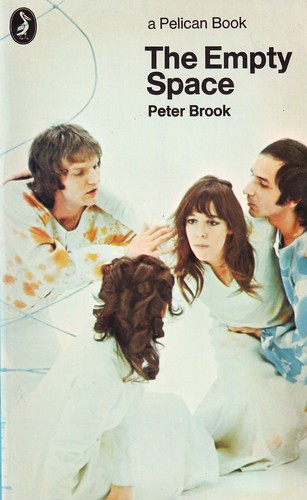
imomus I'm having a Peter Brook week. The radical British director, now 83, has been dominating my video projector; I've watched his Mahabarata (1989), Meetings With Remarkable Men (1979), Marat / Sade (1967), and as much of his King Lear (1971) as YouTube allows (it looks pretty great). I've also been lucky enough to see a Peter Brook theatre production at the Theatre Bouffes du Nord in Paris, an opulent-yet-tatty bobo theatre far from the stark "empty space" of his famous 1960s treatise.
One thing that strikes me about Brook is the nature of the "world theatre" style he's developed. It's certainly an orientalist vision, centred on dignified, spiritually-radiant characters from distant, exotic and "unspoiled" cultures. It's, in other words, a projection onto the other of what the (liberal) West wants and needs it to be.
This vision is generally focused on "timeless, universal storytelling" and features beards, deities, elegant robes and haunting ethnic music. Brook's theatre company mixes-and-matches different ethnicities (there's a Japanese, an African, and so on, all with remarkable, striking faces), cutting and splicing different cultures and traditions in a way which is either calculated to produce some sort of Brechtian alienation (and Brecht is certainly an influence) or to suggest that traditional world theatres all have something in common -- an implied universality which would be the opposite of the alienation effect.
 Often, when you look closer, the stories are wrangled by Western professionals -- omnipresent french scriptwriter Jean-Claude Carriere pulled together the eccentric strings of The Mahabarata, for instance -- and Western music is often mixed with the ethnic sounds ("Meetings With Remarkable Men", for instance, is through-scored rather intrusively). Something about this reminds me of The Incredible String Band's Afghan trips in the late 60s, or the crossing point between the Magic Realism and World genres in the 1980s, or anthropology and travel documentaries which all sound as if they're scored by the same "ethnic" synth sounds, and which all lament -- in a diffusely-humanist, valedictory way -- the disappearance of noble cultures and traditions, encroached upon by our own greed and rapacity.
Something about this -- and the New Age spirituality in the Gurdjieff film -- sticks in my craw a bit, even if I'm essentially a member of the Western bourgeois audience who laps this stuff up and finds it "spiritual" and "beautiful" so on. I associate it with joss sticks and copies of David Sylvian's precious 1980s records "Words with the Shaman" and "Plight & Premonition".
 I also can't help connecting it with something I read recently in Fareed Zakaria's precis of the arguments in his book "The Post-American World" in Newsweek. Zakaria wants to say that the "rise of the rest" (of, in other words, a thoroughly materialist and capitalist India and China) is not bad news for America, and won't come at its expense. He ends his precis with this slightly odd thought: "Generations from now, when historians write about these times, they might note that by the turn of the 21st century, the United States had succeeded in its great, historical mission—globalizing the world. We don't want them to write that along the way, we forgot to globalize ourselves."
What's odd, to me, is the idea that it took America to "globalize the world". Surely the world was already global? What Zakaria probably means is that this was a specific kind of globalization which matched America's aspirations and suited its needs (until relatively recently, when China and India started succeeding beyond anyone's wildest expectations, and beating America at its own game). And that's how I feel about World Theatre (or World Music, for that matter). The world has a huge variety of theatrical traditions, but World Theatre (and I think immediately of certain robes, certain synthesizer sounds, certain notions of "human dignity", and a certain Western audience with its own requirements) is a narrow and recognizable genre, just as World Music is -- a genre defined more by our need to find something beautiful and spiritual and dignifying than by what's actually out there.
(no subject)
Date: 2008-09-24 06:34 pm (UTC)(no subject)
Date: 2008-09-24 08:21 pm (UTC)But I don't think modernity has eroded Japan's "Japaneseness" at all. It has an entirely Japanese way of being modern -- and in many cases more considerably modern than our Western cultures, without being any less alien for it (one tiny example: the Washlet toilet (http://imomus.livejournal.com/97784.html)). Japan, like India, was most influenced by the West up to and during the 1980s, and is now heading away from that admiration, that influence. I think you see that all through Japanese culture -- a tiny example would be the "Matsuri-kei" singer I showcased yesterday. A very Japanese sound, as well as a very digital one, ne?
(I have a piece somewhere about how modernisation in Japan was at one time signified by Western things, but now tends to be signified by digital things, often in combination with traditional Japanese craft and cultural symbols.)
(no subject)
Date: 2008-09-24 08:36 pm (UTC)(no subject)
Date: 2008-09-24 08:41 pm (UTC)You can actually see this shift in the work of a single designer or design collective. When I first became aware of design group Delaware about ten years ago, they were copying American clip art of surfers and water-skiers. Now, especially in the work of departed partner Ten, they're colliding lo-res jaggy graphics with trad Japanese banners and screens.
Ten's website features a "flower arrangement of the week", and a "garden of hexagon patchwork". His big idea is to distill traditional Japanese art and craft forms to their most minimal digital signs, so that they can be displayed on iMode cellphone screens.
For a rising generation of Japanese designers, it seems, making references to traditional Japanese forms is no longer fatal, it's vital."