Taxonomy of the Terry
Sep. 4th, 2008 10:31 am![[personal profile]](https://www.dreamwidth.org/img/silk/identity/user.png) imomus
imomusThe Joe bash at Ä last night turned out to be a 'stache stash -- the kids all have moustaches these days! Here's the one Joe's grown since arriving in Berlin, a pencil-thin affair:

And here are a couple of audience members. The guy on the right works for American Apparel, the guy on the left is rocking the "Terry Look".

The Terry Look refers, of course, to perve photographer Terry Richardson. I used to see him when I lived in New York in 2000 -- he'd be at Alleged Gallery openings on Washington Street. I remember thinking "What an unattractive looking man!" But the important thing was that Terry didn't look like anyone else at that point -- and for good reason; nobody else wanted to look like your funny bald working class uncle from 1976, some kind of ex-marine from Baltimore, with a plaid shirt, tattoos and a moustache. The look went back in time, and went down the social ladder.
That was soon to change, though. Terry's centrality in fashion, the romanticization of white working class styles, and the fact that this sleazy, unapologetic pervert romped with some of the world's most gorgeous women saw to that. When I met Jesse Pearson (editor of Vice magazine) in October 2007 he had the Terry-type moustache too. Last night, I looked around the room at Ä and played "spot the Terries". There were several, all with late 70s, early 80s glasses and moustaches. Terry's unattractive look had somehow become viral. And I found that, because I recognised its viral power, I no longer thought of it, reflexively, as ugly. I'd been rewired, reprogrammed. Now I was quite excited to recognize -- and collect -- Terries. It was an "official look" with a respectable cultural history -- a fashion-sociological fact.
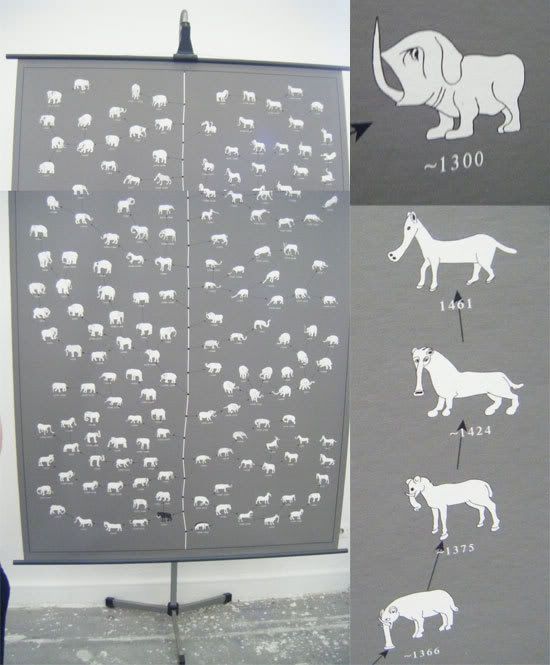
 Talking to Uli Westphal, the artist who made the Elephant Taxonomies chart which was my favourite work at this year's UDK Rundgang, I joked that I was going to make a similar chart about the spread of the fashion moustache: a Taxonomy of Terries.
The Taxonomy of Terries would take the form of a family tree. An image of the real Terry at the top would beget two imitation Terries, who in turn would beget four, eight and sixteen Terry lookalikes, until we'd reach the present, with possibly hundreds of thousands of Terry-types worldwide (and all sorts of Darwinian evolutions of the look -- the Terry with Ray Bans, the Terry whose moustache is a tattoo, the Japanese Terry).
Taxonomies are the subject of my latest piece for Spanish magazine Playground, which is called Down With Linnaeus! Actually, it's called Pasando de Linneo! on the site, which prints only the Spanish version of my column, so, as usual, I'll put the original English version here (under the cut). As you can see from the painting, Linnaeus himself had no moustache, but was, instead, an outrageous orientalist, rocking the Chinese Sage look.
Momus column
Playground magazine
Down with Linnaeus!
It's embarrassing. Creeping into hip indie record stores with our collars pulled up and our caps pulled down, scrupulously avoiding eye contact with the store clerks, we recording artists often like to check to see if our own records are in stock. Are our distributors doing their job? Are we sold out or marked down? Do we have dividers with our name on them, or are we in "M Various"? Are we up on display, with a nice little handwritten recommendation? Do we exist at all in this country, this city, this store? Does anybody still remember us?
Even more embarrassing than searching for your own record is not finding it because you have no idea what genre it's supposed to be in. That's what happened to me last time I went into the Rough Trade store in London's fashionable Truman's Yard. Don't get me wrong -- Rough Trade is a great store, a temple to music. The enthusiasm is palpable as soon as you walk in the door. Unfortunately, the shop is organised by genre. And, in the interests, presumably, of showing just how eclectic and diverse their stock is, there are dozens and dozens of genres, each with its own sets of micro-genres nested inside like Russian dolls.
There they are: Rock-Pop, Reggae-Dub, Techno, House, Breakbeat, Downtempo, Electronic, Country-Folk-Blues, Jazz, Modern Composition, Rap-Hip Hop, Soul-Funk, World, Soundtracks... aisle after aisle, category after category, genre after genre. Select "House", for instance, and you'll discover a new set of micro-genres within the macro-genre: UK / Euro House, Ed Banger, US House, Electro, Electro Pop, Nu Disco. The Rock-Pop genre at the Rough Trade store has 19 sub-categories: Bastard Pop and Indie Pop and Krautrock and Out Rock / Metal and New Folk / Psychedelic and...
Now, this is what naturalists would call a taxonomy: a way to structure the confusion of flora and fauna, bring some order into the garden, some logic into the zoo. But the result is that I'm completely lost. Are my records considered New Folk? Well, one of them is called Folktronic, and a lot of them have sea shanties on them. Nope, not there! Or am I Indie-Pop? I've always recorded for independent labels, but that's not quite the same thing: if everything on an independent label was "Indie-Pop", most of the reggae would be in the Indie-Pop section. Am I in the Japanese section because I've worked with Japanese artists? No, not there. Am I Krautrock because I live and record in Berlin? No, not there either. This is getting tiring -- and the record store employees are beginning to look at me suspiciously. Time to go, disguised only by a big red blush.
Musicians routinely play down genre in interviews. "We don't consider what we do Britpop," said the Britpop artists, "This whole Anti-Folk thing is ridiculous," say the Anti-Folkers. "Don't fence me in!" has become as clichéd an interview statement as "We just make the music we want to hear ourselves, and if anyone else likes it, it's a bonus!" But do musicians have a point? Has genre become a hinderance rather than a help? Do we need to kick Linnaeus -- the botanist known as "the father of taxonomy" -- back to 18th century Sweden?
I think the answer is "yes". I dream of walking into a record store one day and finding everything alphabetically arranged -- rock, pop, reggae, jazz, everything in the same racks. I dream of heavy metal fans searching for Warbringer and finding Wagner, Indie-Pop fans searching for The Pastels and stumbling on Pachelbel, classical fans searching for Ligeti and finding Lullatone.
When you look a little deeper into what genre divisions in record shops are saying, some disturbingly old-fashioned messages emerge. The picture is of music as something tribal, and of each tribe as racially segregated (how many white artists are in the Soul-Funk section, and how many black ones in Krautrock?) and non-miscegenating.
Although the musicians I know synthesize countless genres and draw on traditions from all over the world when they compose and record, although cross-genre sampling and global fusion have become the norm rather than the exception over the last twenty years or so, nobody seems to have told the people who organize record shops. They're still laying out their stores as if musical genres were impermeably racially-segregated, as if musicians confined themselves to narrow, clearly-defined styles. Did Beck live in vain?
It isn't just record shops. What about MySpace, which forces you, if you're uploading music to your page, to choose a genre category for it? A band I recently played with in Berlin, Top Model, chose to mess with the MySpace categories, calling their music "Chinese Traditional / Afro-Beat / Glam Rock". That's a kind of passive aggression, the same kind of mild subversion that makes people fill in their age as "102", but it's also a way of acknowledging that, in this post-globalisation world, you don't have to be Chinese to make Chinese music, nor African to make Afro-Pop. It's a statement about how we're all, these days, genre-splicers.
Rinus Van Alebeek, one of Top Model's members -- the Berlin-dwelling Dutchman plays toy instruments through the built-in speakers on a Casio -- told me why they'd chosen to fuck with MySpace's tags. "Going through the possibilities the MySpace team offers to describe music, I decided to be honest. Chinese Traditional because I play black keys only, which reminds people of simple Chinese songs, Afro-Beat because we use a marimba, and Glam Rock because Mireia's singing links us directly to the Spanish faction of Glam -- those 1970s tearjerkers so generously used by Almodovar in his movies."
Rough Trade, MySpace, if you're reading this, please DON'T add a shelf for 1970s Spanish Glam Rock! If you stock the stuff (and please do!), just lay it out alphabetically. If we're meant to find it, we will. Probably while searching for something else entirely -- that rare Bhangra / Reggaeton fusion album, maybe.
And here are a couple of audience members. The guy on the right works for American Apparel, the guy on the left is rocking the "Terry Look".
The Terry Look refers, of course, to perve photographer Terry Richardson. I used to see him when I lived in New York in 2000 -- he'd be at Alleged Gallery openings on Washington Street. I remember thinking "What an unattractive looking man!" But the important thing was that Terry didn't look like anyone else at that point -- and for
good reason; nobody else wanted to look like your funny bald working class uncle from 1976, some kind of ex-marine from Baltimore, with a plaid shirt, tattoos and a moustache. The look went back in time, and went down the social ladder. That was soon to change, though. Terry's centrality in fashion, the romanticization of white working class styles, and the fact that this sleazy, unapologetic pervert romped with some of the world's most gorgeous women saw to that. When I met Jesse Pearson (editor of Vice magazine) in October 2007 he had the Terry-type moustache too. Last night, I looked around the room at Ä and played "spot the Terries". There were several, all with late 70s, early 80s glasses and moustaches. Terry's unattractive look had somehow become viral. And I found that, because I recognised its viral power, I no longer thought of it, reflexively, as ugly. I'd been rewired, reprogrammed. Now I was quite excited to recognize -- and collect -- Terries. It was an "official look" with a respectable cultural history -- a fashion-sociological fact.
Talking to Uli Westphal, the artist who made the Elephant Taxonomies chart which was my favourite work at this year's UDK Rundgang, I joked that I was going to make a similar chart about the spread of the fashion moustache: a Taxonomy of Terries.The Taxonomy of Terries would take the form of a family tree. An image of the real Terry at the top would beget two imitation Terries, who in turn would beget four, eight and sixteen Terry lookalikes, until we'd reach the present, with possibly hundreds of thousands of
Terry-types worldwide (and all sorts of Darwinian evolutions of the look -- the Terry with Ray Bans, the Terry whose moustache is a tattoo, the Japanese Terry).Taxonomies are the subject of my latest piece for Spanish magazine Playground, which is called Down With Linnaeus! Actually, it's called Pasando de Linneo! on the site, which prints only the Spanish version of my column, so, as usual, I'll put the original English version here (under the cut). As you can see from the painting, Linnaeus himself had no moustache, but was, instead, an outrageous orientalist, rocking the Chinese Sage look.
Momus column
Playground magazine
Down with Linnaeus!
It's embarrassing. Creeping into hip indie record stores with our collars pulled up and our caps pulled down, scrupulously avoiding eye contact with the store clerks, we recording artists often like to check to see if our own records are in stock. Are our distributors doing their job? Are we sold out or marked down? Do we have dividers with our name on them, or are we in "M Various"? Are we up on display, with a nice little handwritten recommendation? Do we exist at all in this country, this city, this store? Does anybody still remember us?
Even more embarrassing than searching for your own record is not finding it because you have no idea what genre it's supposed to be in. That's what happened to me last time I went into the Rough Trade store in London's fashionable Truman's Yard. Don't get me wrong -- Rough Trade is a great store, a temple to music. The enthusiasm is palpable as soon as you walk in the door. Unfortunately, the shop is organised by genre. And, in the interests, presumably, of showing just how eclectic and diverse their stock is, there are dozens and dozens of genres, each with its own sets of micro-genres nested inside like Russian dolls.
There they are: Rock-Pop, Reggae-Dub, Techno, House, Breakbeat, Downtempo, Electronic, Country-Folk-Blues, Jazz, Modern Composition, Rap-Hip Hop, Soul-Funk, World, Soundtracks... aisle after aisle, category after category, genre after genre. Select "House", for instance, and you'll discover a new set of micro-genres within the macro-genre: UK / Euro House, Ed Banger, US House, Electro, Electro Pop, Nu Disco. The Rock-Pop genre at the Rough Trade store has 19 sub-categories: Bastard Pop and Indie Pop and Krautrock and Out Rock / Metal and New Folk / Psychedelic and...
Now, this is what naturalists would call a taxonomy: a way to structure the confusion of flora and fauna, bring some order into the garden, some logic into the zoo. But the result is that I'm completely lost. Are my records considered New Folk? Well, one of them is called Folktronic, and a lot of them have sea shanties on them. Nope, not there! Or am I Indie-Pop? I've always recorded for independent labels, but that's not quite the same thing: if everything on an independent label was "Indie-Pop", most of the reggae would be in the Indie-Pop section. Am I in the Japanese section because I've worked with Japanese artists? No, not there. Am I Krautrock because I live and record in Berlin? No, not there either. This is getting tiring -- and the record store employees are beginning to look at me suspiciously. Time to go, disguised only by a big red blush.
Musicians routinely play down genre in interviews. "We don't consider what we do Britpop," said the Britpop artists, "This whole Anti-Folk thing is ridiculous," say the Anti-Folkers. "Don't fence me in!" has become as clichéd an interview statement as "We just make the music we want to hear ourselves, and if anyone else likes it, it's a bonus!" But do musicians have a point? Has genre become a hinderance rather than a help? Do we need to kick Linnaeus -- the botanist known as "the father of taxonomy" -- back to 18th century Sweden?
I think the answer is "yes". I dream of walking into a record store one day and finding everything alphabetically arranged -- rock, pop, reggae, jazz, everything in the same racks. I dream of heavy metal fans searching for Warbringer and finding Wagner, Indie-Pop fans searching for The Pastels and stumbling on Pachelbel, classical fans searching for Ligeti and finding Lullatone.
When you look a little deeper into what genre divisions in record shops are saying, some disturbingly old-fashioned messages emerge. The picture is of music as something tribal, and of each tribe as racially segregated (how many white artists are in the Soul-Funk section, and how many black ones in Krautrock?) and non-miscegenating.
Although the musicians I know synthesize countless genres and draw on traditions from all over the world when they compose and record, although cross-genre sampling and global fusion have become the norm rather than the exception over the last twenty years or so, nobody seems to have told the people who organize record shops. They're still laying out their stores as if musical genres were impermeably racially-segregated, as if musicians confined themselves to narrow, clearly-defined styles. Did Beck live in vain?
It isn't just record shops. What about MySpace, which forces you, if you're uploading music to your page, to choose a genre category for it? A band I recently played with in Berlin, Top Model, chose to mess with the MySpace categories, calling their music "Chinese Traditional / Afro-Beat / Glam Rock". That's a kind of passive aggression, the same kind of mild subversion that makes people fill in their age as "102", but it's also a way of acknowledging that, in this post-globalisation world, you don't have to be Chinese to make Chinese music, nor African to make Afro-Pop. It's a statement about how we're all, these days, genre-splicers.
Rinus Van Alebeek, one of Top Model's members -- the Berlin-dwelling Dutchman plays toy instruments through the built-in speakers on a Casio -- told me why they'd chosen to fuck with MySpace's tags. "Going through the possibilities the MySpace team offers to describe music, I decided to be honest. Chinese Traditional because I play black keys only, which reminds people of simple Chinese songs, Afro-Beat because we use a marimba, and Glam Rock because Mireia's singing links us directly to the Spanish faction of Glam -- those 1970s tearjerkers so generously used by Almodovar in his movies."
Rough Trade, MySpace, if you're reading this, please DON'T add a shelf for 1970s Spanish Glam Rock! If you stock the stuff (and please do!), just lay it out alphabetically. If we're meant to find it, we will. Probably while searching for something else entirely -- that rare Bhangra / Reggaeton fusion album, maybe.
![[identity profile]](https://www.dreamwidth.org/img/silk/identity/openid.png)
Re: Classify and clarify
Date: 2008-09-04 09:55 am (UTC)I think the answer would have to revolve around race being a materially and stylistically relevant factor in cultural production, and I think it is, but we live in a society which likes to call race immaterial, at least officially.
Re: Classify and clarify
Date: 2008-09-04 10:00 am (UTC)And to return to yr original point, I do dislike the pigeonholing mentality which classifies music by genres, and people by their skin colour, which is why I do what I can to avoid either. And living here in breathtakingly mono-racial, homogenous Poland, that's more of a challenge than it wd be elsewhere in Europe.
Re: Classify and clarify
Date: 2008-09-04 10:11 am (UTC)Re: Classify and clarify
Date: 2008-09-04 06:30 pm (UTC)