Why Bowie's new house won't be by Bow Wow
Jan. 24th, 2008 02:26 am![[personal profile]](https://www.dreamwidth.org/img/silk/identity/user.png) imomus
imomusThe picture below shows, fanned open, all the jpg images I had on my desktop at about 10 o'clock last night. They're basically the result of two data-mining enquiry lines, a Bowie line and a Bow Wow line. Atelier Bow Wow, that is. So, my favourite celebrity and my favourite architecture studio. (Click the picture to see it huge.)

 Having opened these images all up together, I began to make connections between them. At the centre you can see Bowie playing a vicious capitalist refusing a young dot commer a line of finance in Austin Chick's forthcoming film "August". The film is set in 2001, but the room inhabited by Bowie's character is in the pseudo-Victorian style we could call "international rich chintz" or "hotel baroque".
That got me wondering whether the man I associate most fondly with the avant pop experiments of the "Lodger" album has built his new house in Shokan, near Woodstock, yet, and if so, what style it's in? The idyllic woods-and-lake photo below right in my spread is the site, Little Tonshi Mountain.
Google Earth left me none the wiser -- it wouldn't zoom far enough into this remote rural area to show construction, let alone the style of the building taking shape on Bowie and Iman's 64-acre plot in the Catskills. What we do know is that when Bowie commissioned a house on Mustique it was in a sort of Jet Set PoMo style -- a sprawling Balinese fantasy by Swedish architect Arne Hasselqvist, who also made Mustique villas for Mick Jagger and Princess Margaret. (Hasselqvist and his son died tragically in a fire in Nassau in 2001; they initially escaped, but were overcome by smoke when they returned to try to save some documents, possibly architectural plans.)
 Bowie's PoMo "world architecture" house was featured in Architectural Digest magazine in September 1992. I remember running out and buying a copy on Tottenham Court Road, near where I was living at the time, and being a bit disappointed. The cover made it look very alluring and Asian, but inside there was a disappointing lack of personality. Everything was cream cushions and rattan chairs. It looked like a rental villa. Now, Bowie bought the Mustique place in the 80s, when he was particularly close with Mick Jagger, who had his own villa in exactly the same style pretty much next door. So there was probably some enormously-wealthy-rock-star peer pressure going on. But it's a bit disappointing how the rich fail to spend their money on really great architecture, and just go for chintz and "hotel baroque". And of course it's also disappointing -- and this is not unrelated -- when their records cease to be avant and just settle into "timeless" styles too. "Luxury hotel baroque" in your living arrangements seems to lead to "luxury hotel rock" in your music arrangements.
If I had Bowie's money, there's no doubt at all what I'd do. I'd commission Atelier Bow Wow to design my house. But, you know, it occurs to me that there's a reason rock stars, in general, have less-than-cutting-edge taste. If they were unremittingly avant, they'd never have got rich in the first place, because the large publics required to generate large fortunes are essentially conservative. In other words, a rock star rich enough to commission an avant-styled house is unlikely to have remained unaffected enough by his public and his rich peers to want something avant garde in the first place. It's impossible to be that popular without being, in your heart of hearts, somewhat populist in your tastes. And populist, when it comes to architecture, mostly means chintz.
To put that another way, if David Bowie had only made avant pop albums like "Lodger", he probably wouldn't have enough money now to commission the Atelier Bow Wow house he might well -- in that parallel world -- be inclined to crave.
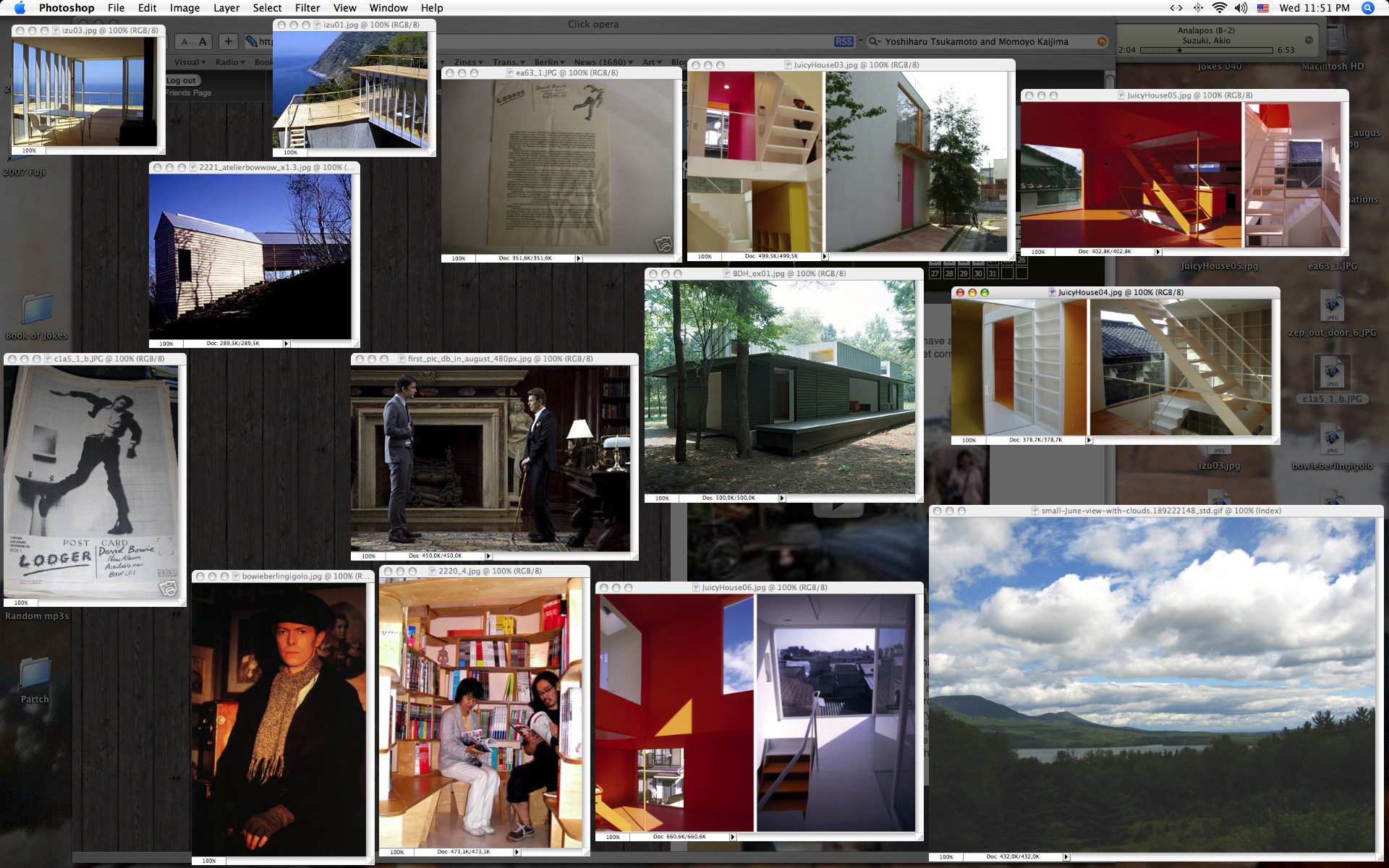 Having opened these images all up together, I began to make connections between them. At the centre you can see Bowie playing a vicious capitalist refusing a young dot commer a line of finance in Austin Chick's forthcoming film "August". The film is set in 2001, but the room inhabited by Bowie's character is in the pseudo-Victorian style we could call "international rich chintz" or "hotel baroque".
That got me wondering whether the man I associate most fondly with the avant pop experiments of the "Lodger" album has built his new house in Shokan, near Woodstock, yet, and if so, what style it's in? The idyllic woods-and-lake photo below right in my spread is the site, Little Tonshi Mountain.
Google Earth left me none the wiser -- it wouldn't zoom far enough into this remote rural area to show construction, let alone the style of the building taking shape on Bowie and Iman's 64-acre plot in the Catskills. What we do know is that when Bowie commissioned a house on Mustique it was in a sort of Jet Set PoMo style -- a sprawling Balinese fantasy by Swedish architect Arne Hasselqvist, who also made Mustique villas for Mick Jagger and Princess Margaret. (Hasselqvist and his son died tragically in a fire in Nassau in 2001; they initially escaped, but were overcome by smoke when they returned to try to save some documents, possibly architectural plans.)
Bowie's PoMo "world architecture" house was featured in Architectural Digest magazine in September 1992. I remember running out and buying a copy on Tottenham Court Road, near where I was living at the time, and being a bit disappointed. The cover made it look very alluring and Asian, but inside there was a disappointing lack of personality. Everything was cream cushions and rattan chairs. It looked like a rental villa. Now, Bowie bought the Mustique place in the 80s, when he was particularly close with Mick Jagger, who had his own villa in exactly the same style pretty much next door. So there was probably some enormously-wealthy-rock-star peer pressure going on. But it's a bit disappointing how the rich fail to spend their money on really great architecture, and just go for chintz and "hotel baroque". And of course it's also disappointing -- and this is not unrelated -- when their records cease to be avant and just settle into "timeless" styles too. "Luxury hotel baroque" in your living arrangements seems to lead to "luxury hotel rock" in your music arrangements.If I had Bowie's money, there's no doubt at all what I'd do. I'd commission Atelier Bow Wow to design my house. But, you know, it occurs to me that there's a reason rock stars, in general, have less-than-cutting-edge taste. If they were unremittingly avant, they'd never have got rich in the first place, because the large publics required to generate large fortunes are essentially conservative. In other words, a rock star rich enough to commission an avant-styled house is unlikely to have remained unaffected enough by his public and his rich peers to want something avant garde in the first place. It's impossible to be that popular without being, in your heart of hearts, somewhat populist in your tastes. And populist, when it comes to architecture, mostly means chintz.
To put that another way, if David Bowie had only made avant pop albums like "Lodger", he probably wouldn't have enough money now to commission the Atelier Bow Wow house he might well -- in that parallel world -- be inclined to crave.
![[identity profile]](https://www.dreamwidth.org/img/silk/identity/openid.png)
(no subject)
Date: 2008-01-24 07:05 am (UTC)$2.99 bookshelves
(no subject)
Date: 2008-01-24 07:21 am (UTC)It costs nothing to sit on the floor on pillows alá Japon, and that never caught on in the west... people dont like the aesthetic, they find it weird. Cost doesnt always dictate taste.
(no subject)
Date: 2008-01-24 07:23 am (UTC)Don't look too hard for a disagreement here.
(no subject)
Date: 2008-01-24 07:34 am (UTC)(no subject)
Date: 2008-01-24 07:37 am (UTC)(no subject)
Date: 2008-01-24 07:40 am (UTC)(no subject)
Date: 2008-01-24 07:47 am (UTC)Now, put those two facts together and you get something interesting -- a company that sets standards rather than following them. A company that's somewhat Reithian in its desire to give people what they don't necessarily want, at a price they can't ignore. I think if Ikea had shareholders, we'd see some pressure to make more chintz available in the stores. It would certainly wider Ikea's appeal. But Ikea isn't like that. It sets the standards. And this is down to Kamprad and his enormous wealth, his clear aesthetic goals. But it's also down to the nature of Sweden's difference from other nations: the fact that Sweden is different in an aspirational way. It's seen as being ahead. The idea of "the progressive" is not irrelevant here, and not dead. People actually don't like what they see at Ikea, but they feel that its taste might be "ahead" of theirs, and the price seduces them, and soon they do begin to respect the design values too.
(no subject)
Date: 2008-01-24 09:28 am (UTC)Modernist minimalism might be a little more edgy than chintz, but it has been adopted by the mainstream; Ikea is proof.
(no subject)
Date: 2008-01-24 09:43 am (UTC)(no subject)
Date: 2008-01-24 11:12 am (UTC)I have come to the conclusion from this video, kumakouji
Date: 2008-01-24 08:21 am (UTC)Momus= the baby
Re: I have come to the conclusion from this video, kumakouji
Date: 2008-01-24 08:29 am (UTC)Re: I have come to the conclusion from this video, kumakouji
Date: 2008-01-24 09:42 am (UTC)Seeing as you've brought him up, I wanna ask you a few questions:
1) Matsumoto's most famous film is a piece of gay cinema, Bara no Souretsu... was he gay? It doesnt really matter either way, I'm just curious.
2) Have you heard blues control (http://www.myspace.com/bluescontrol)'s 2007 LP 'Puff'? Its fantastic... I can't help but draw parallels between the first track on it, 'Puff', and Matsumoto's film "Song of Stone". Do you notice it too or is it just me?
Re: I have come to the conclusion from this video, kumakouji
Date: 2008-01-24 11:10 am (UTC)Hadn't heard Blues Control before -- it's got some nice textures, but I prefer the Matsumoto soundtracks sonically. More organic and subtle electronics, and made 50 years ahead of Blues Control.
Re: I have come to the conclusion from this video, kumakouji
Date: 2008-01-24 08:06 pm (UTC)(no subject)
Date: 2008-01-24 08:29 pm (UTC)To many it was impractical to move around often with furniture that wasn't as flexible. So, in a way, it was a "practical solution to an impractical behavior".
There is a book on IKEA's history I've been thinking about reading. I might get back to you about this.