![[personal profile]](https://www.dreamwidth.org/img/silk/identity/user.png) imomus
imomusOn the coldest day of the winter so far, Hisae and I took refuge yesterday in the Ostbahnhof branch of "Profi-Baumarkte" Hellweg. The main draw was the pet shop, but I got pretty bored looking at the fluffy bunnies and drifted off to the power tools section.
Now, I'm an aesthete. For me, the forms of power tools primarily summon up some kind of mysterious otherness. I frame them in purely aesthetic terms -- I love the colours, the weird shapes, the rational insanity of them. I also throw cultural frames around them -- the coolest stuff at Hellweg is kit by Einhell, a German brand with a very German solidity and conservatism to its forms. (And yet isn't there something funky, almost Nu-Rave about it too? Remember Altern 8?)

Here, then (from Einhell, but also Silverline, Makita, Sealey) are wondrous strange garden spreaders, sawing tables, electric generators, compressors, lathes, submersible pumps, bench drills, stick electrodes, gas heating reflectors, abrasive cut off saws, welding tools, aprons and gloves in primary colours, air accessory kits with quick couplings, dust free systems, shortwave infrared paint dryers, suction feed paraffin spray guns, nitrile gauntlets for use with thinners, and all sorts of other wonderful things I'll never, ever use, but am happy to stand and gawk at -- the way you might gaze in wonder at technology from a vanished superpower (Soviet-era space equipment, for instance).
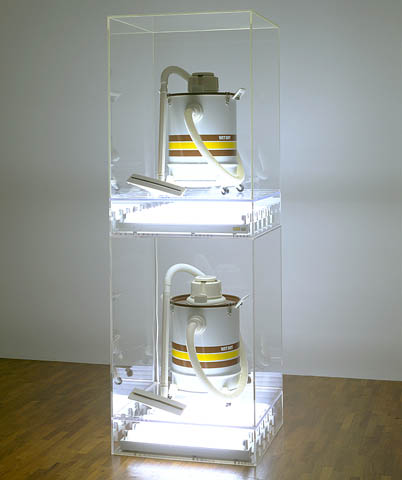
Call it a "consumerism of the uselessly functional". Call it an ostranenie operation carried out on consumer desire in general ("Lovely, but what would I do with all this kit?"). Call it a poignant tension between the useful and the useless, the macho and the gay, the rockist and the pop. You can't help thinking of putting this stuff in an art gallery, but of course Koons has already done it (with his fetishistically clean industrial vacuums).
You also can't help (well, if you're me, anyway) remembering the kerfuffle that occurred at the London Design Museum in September 2004, when vacuum cleaner innovator James Dyson resigned as chairman of the board of trustees, accusing the museum of promoting "empty styling" over "function-led, problem-solving design". There's a gender element, an element of pure machismo, in the story: the final straw for Dyson, apparently, was the museum's replacement of a display of inventions and functional design products with an exhibition on 1950s flower arranger Constance Spry.

As I pointed out when I wrote my article on design rockism for AIGA Voice, matters aren't always that simple:
"Post-protestants desire functionality in ways that go beyond the merely pragmatic, and stray into the areas of the ethical, the cultural, the aesthetic, the psychological, the irrational. Jerry Seinfeld has a sketch about how men go and just watch other men when they’re doing DIY, because they have a magnetic attraction to the machismo of tools. Sure, it looks functional, but it’s also an aesthetic attraction, an irrational impulse deep within a certain kind of man. The rockists in the Dyson affair are incensed that the Design Museum should stage a flower arrangement show, but they don’t consider that their own attachment to functionality may be just as subjective, as aesthetic and as irrational as any response to Constance Spry’s flowers."
Think of today's beautiful collection of power tools, then, as a sort of "flower arrangement for men". Can't you just smell the suction-pumped paraffin?
Now, I'm an aesthete. For me, the forms of power tools primarily summon up some kind of mysterious otherness. I frame them in purely aesthetic terms -- I love the colours, the weird shapes, the rational insanity of them. I also throw cultural frames around them -- the coolest stuff at Hellweg is kit by Einhell, a German brand with a very German solidity and conservatism to its forms. (And yet isn't there something funky, almost Nu-Rave about it too? Remember Altern 8?)
Here, then (from Einhell, but also Silverline, Makita, Sealey) are wondrous strange garden spreaders, sawing tables, electric generators, compressors, lathes, submersible pumps, bench drills, stick electrodes, gas heating reflectors, abrasive cut off saws, welding tools, aprons and gloves in primary colours, air accessory kits with quick couplings, dust free systems, shortwave infrared paint dryers, suction feed paraffin spray guns, nitrile gauntlets for use with thinners, and all sorts of other wonderful things I'll never, ever use, but am happy to stand and gawk at -- the way you might gaze in wonder at technology from a vanished superpower (Soviet-era space equipment, for instance).
Call it a "consumerism of the uselessly functional". Call it an ostranenie operation carried out on consumer desire in general ("Lovely, but what would I do with all this kit?"). Call it a poignant tension between the useful and the useless, the macho and the gay, the rockist and the pop. You can't help thinking of putting this stuff in an art gallery, but of course Koons has already done it (with his fetishistically clean industrial vacuums).
You also can't help (well, if you're me, anyway) remembering the kerfuffle that occurred at the London Design Museum in September 2004, when vacuum cleaner innovator James Dyson resigned as chairman of the board of trustees, accusing the museum of promoting "empty styling" over "function-led, problem-solving design". There's a gender element, an element of pure machismo, in the story: the final straw for Dyson, apparently, was the museum's replacement of a display of inventions and functional design products with an exhibition on 1950s flower arranger Constance Spry.
As I pointed out when I wrote my article on design rockism for AIGA Voice, matters aren't always that simple:
"Post-protestants desire functionality in ways that go beyond the merely pragmatic, and stray into the areas of the ethical, the cultural, the aesthetic, the psychological, the irrational. Jerry Seinfeld has a sketch about how men go and just watch other men when they’re doing DIY, because they have a magnetic attraction to the machismo of tools. Sure, it looks functional, but it’s also an aesthetic attraction, an irrational impulse deep within a certain kind of man. The rockists in the Dyson affair are incensed that the Design Museum should stage a flower arrangement show, but they don’t consider that their own attachment to functionality may be just as subjective, as aesthetic and as irrational as any response to Constance Spry’s flowers."
Think of today's beautiful collection of power tools, then, as a sort of "flower arrangement for men". Can't you just smell the suction-pumped paraffin?
![[identity profile]](https://www.dreamwidth.org/img/silk/identity/openid.png)
(no subject)
Date: 2008-01-05 12:35 am (UTC)I don't have a dog in this fight but your characterization of Dyson's objection seems a little off compared with what he says in the article to which you link. He claims he appreciates all forms of design but wanted balance, especially since he believes that the Design Museum's original brief was to "showcase design of the manufactured object".
(no subject)
Date: 2008-01-05 12:58 am (UTC)Men v. women
Alice Rawsthorn and Constance Spry v. Terence Conran and James Dyson
Engineering, problem-solving, functionalism (advocated by the men)
Style and the fickle finger of fashion (advocated by the women, according to the men)
My take adds another binary
Modernism v. postmodernism
Form follows function is of course the mantra of Modernism. But in the consumer Post-Modern age everything follows the logic of appearance, surface, seduction and desire. Even function has to be seen under the sign of sublimated desire. And you don't have to de-sublimate very much to see that men's attachment to power tools, dressed up as "functionalism" or not, is connected to their feelings about their penises. "Functionalism", in other words, is about desire too. There was a clear understanding of this in Modernist art (surrealism with its "electro-sexual sewing machines" and so on), but not in Modernist design. It's taken until the Post-Modern period for design to take desire and the irrational on board. Dyson apparently hasn't. Which is odd, because his vacuum cleaner was a consumer success largely because of how radically different it looked. It's the Nu-Rave vacuum cleaner!
Grace
Date: 2008-01-05 04:27 am (UTC)(no subject)
Date: 2008-01-05 06:20 am (UTC)The new hand-size circular saws are much more agile and handsome than their larger, clumsier predecessors. And I love my little Dremmel multi-tool.
"Machismo" and "Dyson" in the same sentence brings a wry smile to the lips: A nelly prisspot who built a device for endless sucking on a grand scale, no less.
My favorite device that I own is this air mover. (http://img.alibaba.com/photo/11475117/Turbo_Drier_Air_Mover_Carpet_Drier.jpg) Looks like a big blue snail. Elegant thing. Dries out a basement in nothing flat, too.
Still, I much prefer flowers. "Constance Spry" is a name too good to be true.
(no subject)
Date: 2008-01-05 07:07 am (UTC)(no subject)
Date: 2008-01-05 07:08 am (UTC)Just out of curiosity, have you ever shot a gun before?
(no subject)
Date: 2008-01-05 09:26 am (UTC)(no subject)
Date: 2008-01-05 09:40 am (UTC)I find it interesting that you have, really! I can only imagine you shooting guns when you were young.
(no subject)
Date: 2008-01-05 11:40 am (UTC)We can tiptoe through the tulips that won´t be out yet then (or maybe they will if it´s warm!)
(no subject)
Date: 2008-01-05 11:44 am (UTC)Rawsthorn was accused not only of an emphasis on style rather than function, but of courting corporate money (she came to the Design Museum from the Financial Times). So we could refine the stereotypical binaries at play in the dispute thusly:
* IHT / Wallpaper / Monocle clique of women and homosexuals interested in design as "luxurious decadence", and interested in wealth and corporate sponsorship but, ironically, not wealthy themselves. Stereotyped as fey, superficial, opportunistic, aspirational.
* Design aristocracy represented by Sir Terence Conran and James Dyson. Heterosexual and rich, these men think design is about function, not decoration (Isambard Kingdom Brunel, not Constance Spry). Stereotyped as slightly macho self-made men, well-connected. Despite their personal wealth -- or because of it -- they don't court corporate sponsorship.
Makita sentimentalism
Date: 2008-01-05 11:48 am (UTC)The incorporation of design aesthetic in tools is a relatively recent phenomenon, even ten years ago most tools available tended toward a brute functionality - that functionality frequently being compromised by a lack of even utilitarian design principle.
Can you pick me up a decent screwgun by the way?
Thomas S.
Re: Makita sentimentalism
Date: 2008-01-05 12:00 pm (UTC)The idea that no-design (in terms of outward styling) might result in something more aesthetically pleasing than high-profile consumer design brings this stuff close to the idea of the supernormal (http://imomus.livejournal.com/318683.html) recently promoted by Jasper Morrison and Naoto Fukasawa, and also to Tom Dixon's new design policy at Artek (http://imomus.livejournal.com/285092.html) of sustainable, worn design which is as close as possible to "not-designed" (or, at the very least, not shiny and pristine like his 90s work).
No Rave
Date: 2008-01-05 12:36 pm (UTC)Re: Makita sentimentalism
Date: 2008-01-05 12:49 pm (UTC)It is perhaps interesting that my Makita screwgun is in terms of handling better designed than my Canon SLR... and also looks better.
That said - with the exception of underwater cameras, SLR design has been in the doldrums for the almost twenty years, odd tweaks here and there with the present product - if you will excuse the automotive analogy - resembling a hybrid between an Italian sports car cliche and a hearse.
I want a camera that actually fits my hand and has the exposure compensation in the right place... and does it come in fluorescent blue?
That May 10th/ 2007 article was one of your best of last year by the way, one of those that I suspect got more click than comment.
Thomas S.
Hornbach
Date: 2008-01-05 12:50 pm (UTC)Re: No Rave
Date: 2008-01-05 01:06 pm (UTC)You'll be carrying a quick-coupling air accessory kit with you at all times in about six months, I guarantee, or your no-money back! And then the smile will be on the other side of your no-face!
Re: Hornbach
Date: 2008-01-05 01:06 pm (UTC)Re: No Rave
Date: 2008-01-05 01:09 pm (UTC)Re: Hornbach
Date: 2008-01-05 01:10 pm (UTC)(no subject)
Date: 2008-01-05 01:32 pm (UTC)(no subject)
Date: 2008-01-05 01:37 pm (UTC)Anyway, that's the limit of my DIY skills: hammering out a new desktop image.
Re: Makita sentimentalism
Date: 2008-01-05 01:41 pm (UTC)Nu-Rave Wabi-sabi
Date: 2008-01-05 01:46 pm (UTC)Their mixture of aesthetics and textures might resemble a closing gap between Nu-Rave-ish functionality and Artek's wabi-sabi...
- jan (from hobrechtstr)
Re: Makita sentimentalism
Date: 2008-01-05 01:49 pm (UTC)Re: Makita sentimentalism
Date: 2008-01-05 01:53 pm (UTC)