Frozen world of the familiar stranger
Dec. 24th, 2007 09:54 am![[personal profile]](https://www.dreamwidth.org/img/silk/identity/user.png) imomus
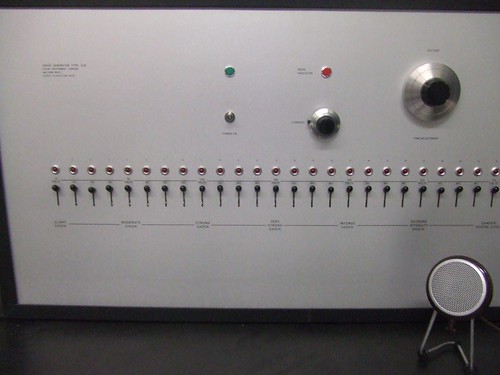
imomus At Kunst-Werke, here in Berlin, there's currently an excellent Reenactment by the artist Rod Dickinson of psychologist Stanley Milgam's famous experiment into authoritarian obedience -- the one where he got experimental subjects to administer increasingly severe electric shocks to a man with a heart condition. It was a sham -- no shocks were given -- but a frighteningly large number of people went all the way to 450 volts, even when the "victim" in the other room stopped responding altogether. They "killed" the victim in order not to disobey orders.
Conducted in the early 60s, "the Milgram experiment" (as it's come to be known) was basically concerned with the recent past: how Nazi Germany could have happened. It's likely (though not certain) that people today would question the white-coated psychologist's authority more readily and stop the torture more quickly. But Milgram did some other famous experiments which are more relevant to our times, experiments into social relatedness that delight today's researchers into network theory, social networking sites and bluetooth phone technology. In the 70s, Milgram came up with two big ideas, the "six degrees of separation" idea and the "familiar stranger" idea.
Familiar Strangers are people who aren't totally unknown to us, but aren't acquaintances either. We might see them every day on our commute to work. We have a sort of unspoken pact with our Familiar Strangers, a pact not to communicate, even though we may recognize each other. This isn't an unfriendly pact, we simply agree to maintain anonymity. It's a pact basic to city life -- in the interestts of sanity, streamlining, simplicity we agree to stay "visual but not verbal" with most people, even though we might know them by sight, and even have invested quite a lot of energy in imagining their lives. Milgram's study was based on two projects he conducted in 1971, one at CUNY and the other at a train station. He published the results in two papers, "The Familiar Stranger: An Aspect of Urban Anonymity", 1972 and "Frozen World of the Familiar Stranger", 1974.

There was an element of perplexity in Milgram's attitude to the Familiar Stranger, something that links it to his electric shocks experiment. How, he wondered, could people be so cold and indifferent to their fellow human beings? "Fellow commuters, he decided, are like trees, posts, and billboards -- regarded as scenery, not as people with whom to talk and exchange greetings. Milgram called these people familiar strangers, for they encountered each other daily but never introduced themselves. Instead, they stood in clusters, back to back, staring straight ahead. "I found a particular tension in this situation,'' he confessed."
 Increasingly, though, we've seen this kind of relationship as something desireable. For instance, designers of social networking software like MySpace and Facebook seek ways to increase the user's encounter with Familiar Strangers. How do you "see that girl about" on their sites? How do you make an intermediate level between friends and non-friends? It's also a subject of great interest to researchers adding capabilities to bluetooth-equipped phones, which can recognize other bluetooth phones they come frequently into proximity with, even if the phones' owners have no direct contact with each other.
The Familiar Stranger idea is one that interests me. I'm not one of those people who reads about this and resolves to talk to his Familiar Strangers in future; I'm quite happy to see the agreement not to communicate as essentially a harmonious one, part of the smooth running of the large modern city. I don't particularly like to clutter up my day with chatter, and I don't think urban alienation is particularly a "problem". In fact, Milgram's experiments come from a time when alienation was a fashionable theme for sociologists and psychologists, perhaps because it was fashionable in humanist literature. Books like David Riesman's The Lonely Crowd (1953) described a large subsection of Americans in almost Existentialist terms: they were a "lonely crowd" of other-directed individuals equipped with a sort of internal radar which made them "capable of a rapid if sometimes superficial intimacy with and response to everyone". In Riesman's terms, I'm more of an "inner-directed" -- having to do this "rapid, superficial intimacy" thing is a bit of a torture to me. I prefer to daydream about people than chat with them.
When Hisae and I were in Venice last month, we had a Familiar Strangers experience. On our first night there we went to a bar on the Campo Santa Margherita. A couple sat nearby who were quite like us -- she was Japanese, he was a bit older, looked like an artist of some sort, and seemed kind of sleazy (in other words, you knew he had to be charming or famous to overcome the natural disadvantage of looking a bit like a homeless person). We didn't speak to this couple, but for the next couple of days they popped up everywhere we were -- at the Biennale, at a Vivaldi exhibition in a church, at some of the palazzi, in restaurants. Rather than talk to them, I started taking sneaky photographs of them. Hisae and I made up stories about who they were, what was going on in their relationship.This sort of speculation is one of the pleasures of Familiar Strangerdom. If you make it public, though, you run the risk of being confronted by your Stranger. When I wrote something earlier this year about sitting next to an avant-garde artist called Shelley Hirsch at a concert in Ausland, I somehow didn't think that Shelley herself might read and be hurt by the piece, which details a Familiar Stranger encounter with her. But when I saw the Milgram Reenactment at Kunst-Werke recently Shelley was there too. She recognized me and introduced herself. "Remind me where we met?" I said, failing to recognize her. "We didn't, but you wrote something about me that was very hurtful," said Shelley. We patched things up somewhat, but not before Shelley had accused me of being "arrogant" for eavesdropping at Ausland rather than introducing myself directly. But that's not my style; I'd much rather eavesdrop. I'd rather preserve Strangeness than get too Familiar. Half of that account, though, is about me familiarizing myself with Shelley's work when I got home -- and liking and recommending it. And that's my ideal way to relate to people, through their work. Sure, it only works with artists, but it's something that's expanding as we all become more media-active, as we self-mediate on the web. It's possible to follow non-artists now in the way we once might have followed artists -- through their media trails.
I particularly like art which is about the Familiar Stranger effect. I'd cite Sophie Calle's work -- she's done a lot of pieces about following strangers on the street, for instance. Or David Crawford's Stop Motion Studies. Or the work of Cosmic Wonder designer Yukinori Maeda, who once made a piece in which he dressed my friends Toog and Flo (amongst other models) in scraps of clothes seen in 1970s photos of anonymous strangers he'd collected from fleamarkets. I wrote about it under the title We didn't quite meet. Quoting my song "The Shoesize of the Angel", I said then that "the people you've just missed meeting and the places you've never quite been are often the most intriguing ones". They're intriguing, I suppose, because imagination is often better than reality.Don't get too familiar, stranger!
![[identity profile]](https://www.dreamwidth.org/img/silk/identity/openid.png)
(no subject)
Date: 2007-12-24 09:51 am (UTC)(no subject)
Date: 2007-12-24 11:10 am (UTC)Digressing slightly, I recently read a blog entry by Lauren Gelman (http://cyberlaw.stanford.edu/blog/lauren-gelman"), who works for Stanford Law School's Centre of Internet & Society, discussing this very issue.
She made the point that the open nature of the internet could possibly lead to stricter levels of self censorship in the future amongst normal people out of fear their opinions will be forever stored online for everyone to see, thus stifling a lot of the internets value as a tool for debate. She argued that part of growing as a person is to have debates and discussions freely and honesty, and that these experiences shape and mold people into who they are.
She predicts that as the internet becomes a larger part of our social lives and as time goes on, we'll see public figures such as politicians and leaders in the future shamed and villified for brash opinions they might have expressed on the internet in their youth. As the public starts to realise the scale of the issue ie. that you can track someones every past expressed opinion online, they'll become wary of being honest and open, stifling debate and free speech.
To prevent this from happening we need to learn to adapt our behaviour to what we dicover on the internet. Just as we all ignore the familiar strangers to make life in a modern urban enviroment run more smoothly (a move that on the face of it seems harsh and cold) I think it will be important for us all to question the legitimacy of someone's "media footprints", to learn to turn a blind-eye to someones internet past, and allow people to make mistakes and grow as people. Of course, this all raises complicated questions regarding identity...
(no subject)
Date: 2007-12-24 11:20 am (UTC)But of course politics isn't just having opinions. It's having power. And I'd welcome seeing the internet used more for actual political decision-making. Referenda, for instance. I think that's possibly the only way we could revitalize the political process now.
BRAINS OR GTFO
Date: 2007-12-24 11:42 am (UTC)(no subject)
Date: 2007-12-24 11:45 am (UTC)RAPINGSTEEN IS COMING TO TOOOWWN
Date: 2007-12-24 11:46 am (UTC)FALOLOLOLOL LOLOLOLOL
(no subject)
Date: 2007-12-24 12:02 pm (UTC)WHAT WAS ONCE TREMULOUS TISSUE AND MEMBRANE WAS NOW A FOLLICLE AND FULLY FORMED VAGINA!
OVERGROWN AND MYSTERIOUS
UNREVEALING AND STILL TO THE UNTRAINED EYE.
(no subject)
Date: 2007-12-24 12:05 pm (UTC)DECK THE MOMUS WITH RAPINGSTEEN
Date: 2007-12-24 02:13 pm (UTC)ON A ONE EYE OPEN MOMUS
ALL THE FIELDS WE MOMUS
MOMUSING ALL THE WAY!
BELLS ON BOB-MOMUSES MOMUS
MOMUSING SPIRITS MOMUS
WHAT MOMUS IT IS TO MOMUS AND MOMUS
MOMUS MOMUS MOMUS MOMUS MOMUS MOMUS
Re: KNIFE PEEN RAPE TO THE FRONT DESK PLS
Date: 2007-12-24 02:19 pm (UTC)(no subject)
Date: 2007-12-24 02:21 pm (UTC)SOMEONE WANTS TO TAKE YOU FOR A MOMUS
Date: 2007-12-24 02:22 pm (UTC)LOUDER AND SOFTER
CLOSER AND NEARER
THEN AGAIN
Re: SOMEONE WANTS TO TAKE YOU FOR A MOMUS
Date: 2007-12-24 02:31 pm (UTC)(no subject)
Date: 2007-12-24 02:42 pm (UTC)(no subject)
Date: 2007-12-24 02:43 pm (UTC)HARK THE HERALD LOLZERS SING
Date: 2007-12-24 02:45 pm (UTC)(no subject)
Date: 2007-12-24 02:48 pm (UTC)(no subject)
Date: 2007-12-24 02:51 pm (UTC)(no subject)
Date: 2007-12-24 02:54 pm (UTC)(no subject)
Date: 2007-12-24 03:06 pm (UTC)(no subject)
Date: 2007-12-24 03:32 pm (UTC)Is it snowing there in Texas?
(no subject)
Date: 2007-12-24 04:21 pm (UTC)And if you act right now you'll get the special Holiday edition which includes The Making of Go Fuck Yourself Mr. Cheney (http://www.youtube.com/watch?v=wwNiVZWuQpE)
Happy Holidays Mr. Momus
(no subject)
Date: 2007-12-24 04:32 pm (UTC)Bravo kumakouji !
http://www.eff.org/ (http://www.eff.org/)
(no subject)
Date: 2007-12-24 04:36 pm (UTC)aye, there's the rub.
(no subject)
Date: 2007-12-24 06:02 pm (UTC)Would it be a foreground/background kind of thing, Familiar Strangers?
The mutually perceived see each other as scenery, not people, and as background we can imagine them to be what we imagine them to be... and it boils back to the quote on your wikipedia entry about the girl's drawing you put yourself in... you became too real in her secret world, as Peter Gabriel might say. Merry Consumermas Nick!
(no subject)
Date: 2007-12-24 08:19 pm (UTC)new economy
Date: 2007-12-25 01:13 am (UTC)(no subject)
Date: 2007-12-25 04:29 am (UTC)(no subject)
Date: 2007-12-27 06:30 am (UTC)